
Blog3/4/2026
Best Budget: The Golden Age of High-Value, Low-Cost Tech
9 mins Read
The Briefing
Quick takeaways for the curious
The concept of 'Best Budget' reframes value as a balance of performance, durability, and aesthetics rather than the lowest price.
The era of 'premium tax' is fading as diminishing returns show most users get 90% of flagship functionality at about 40% of the price, making mid-range options highly compelling.
Smart budgeting now means strategic acquisition: prioritize core experiences and build a long-term, debt-free lifestyle rather than chasing elite bells and whistles.
Feature fatigue and the Journal of Consumer Research-inspired insights indicate extra performance on premium items often does not translate into real-world happiness.
The 'Best Budget' mindset represents a sophisticated consumer choice—a golden age of high-performance living without unnecessary cost, debt, or compromise on essence.
The High-Value Revolution: Redefining the "Budget" Philosophy in an Era of Premium Fatigue
We are currently navigating a fascinating era of "Value Realism," a cultural and economic pivot where the prestige of the price tag is being systematically dismantled by the sheer competence of the mid-range. For the better part of two decades, the consumer narrative was driven by a binary choice: you either paid a "Premium Tax" for cutting-edge innovation and status, or you settled for "Budget" alternatives that were defined by compromise, fragility, and a palpable lack of soul. But the tide has turned. We are moving away from the era of "disposable cheapness" and into an era of "strategic acquisition." The rise of the high-value budget category represents more than just financial prudence; it is a sophisticated rebellion against diminishing returns. It is no longer about finding the lowest price; it is about identifying the "sweet spot" of the curve—the point where performance, durability, and aesthetic meet at a price that respects the consumer’s intelligence. This is the new "Golden Age" of savvy consumption—a time when the gap between a $1,000 flagship and a $400 "budget hero" has narrowed to a sliver, allowing us to curate high-performance lives without the high-performance debt.
The Law of Diminishing Returns: Why "More" No Longer Means "Better"
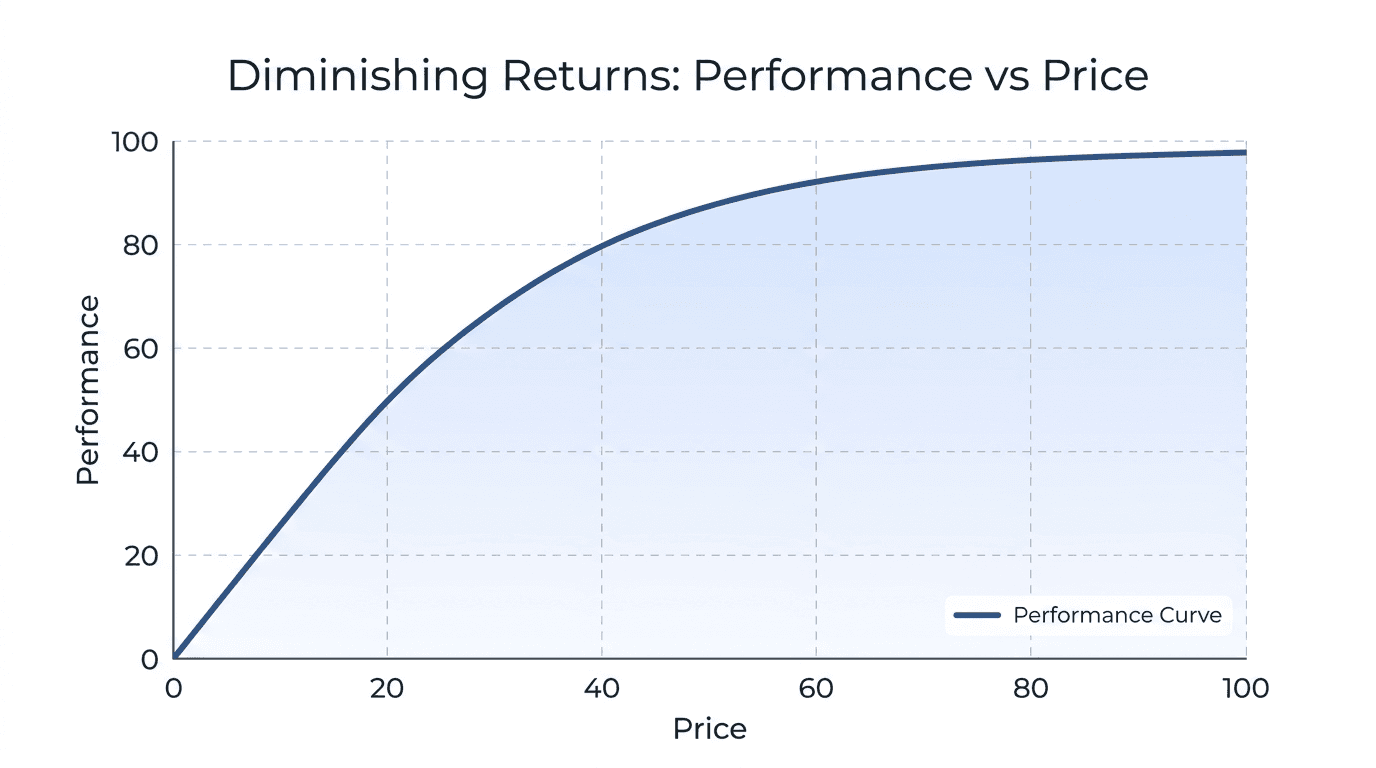
To understand why the budget category is currently dominating the zeitgeist, we must first examine the economic principle of diminishing returns. In the world of high-end consumer goods—whether it’s audiophile headphones, smartphone cameras, or kitchen appliances—there is a point of inflection where the price begins to climb exponentially while the performance gains become marginal, often invisible to the average user.
In the tech sector, this is frequently referred to as the "90% Rule." For approximately 40% of the price of a flagship product, a consumer can now regularly obtain 90% of the functionality. The remaining 10% of performance—that extra 2% of CPU clock speed, the slightly faster wireless charging, or the titanium frame—is where the "Premium Tax" resides. Research suggests that for most consumers, these marginal gains do not translate into a measurable increase in utility or happiness. A study by the Journal of Consumer Research indicates that "feature fatigue" often sets in when users realize they have paid for complexity they do not use. Consequently, the "Best Budget" option is often the most rational choice, providing the core experience of a luxury item without the baggage of unnecessary bells and whistles.
The Democratization of Manufacturing: How the "Hidden Gems" Are Made
The reason we can even have a conversation about high-quality budget goods today is due to the radical democratization of the global supply chain. Ten years ago, the specialized machinery required to produce high-resolution OLED screens or precision-milled aluminum chassis was the exclusive domain of industry titans. Today, those manufacturing processes have matured and scaled, becoming accessible to smaller, leaner "disruptor" brands.
These brands often operate on a "Direct-to-Consumer" (DTC) model, stripping away the massive overhead costs associated with traditional retail: brick-and-mortar storefronts, celebrity endorsements, and multi-million dollar Super Bowl ad campaigns. When you buy a "Best Budget" recommendation from a brand like Anker or Moondrop, you aren't paying for the marketing department's lunch; you are paying for the bill of materials. This shift has created a class of "Budget Heroes"—products that use the exact same sensors, chips, or fabrics as their luxury counterparts but deliver them in a no-nonsense package.
"The reason the 'budget' sector is winning is that 'cheap' is no longer a dirty word. In a world where manufacturing standards have hit a high baseline, the difference between a $500 product and a $1,500 product is often just the logo and the ego." — Marcus Thorne, Consumer Tech Analyst
The "Boots Theory" and the Paradox of Strategic Spending
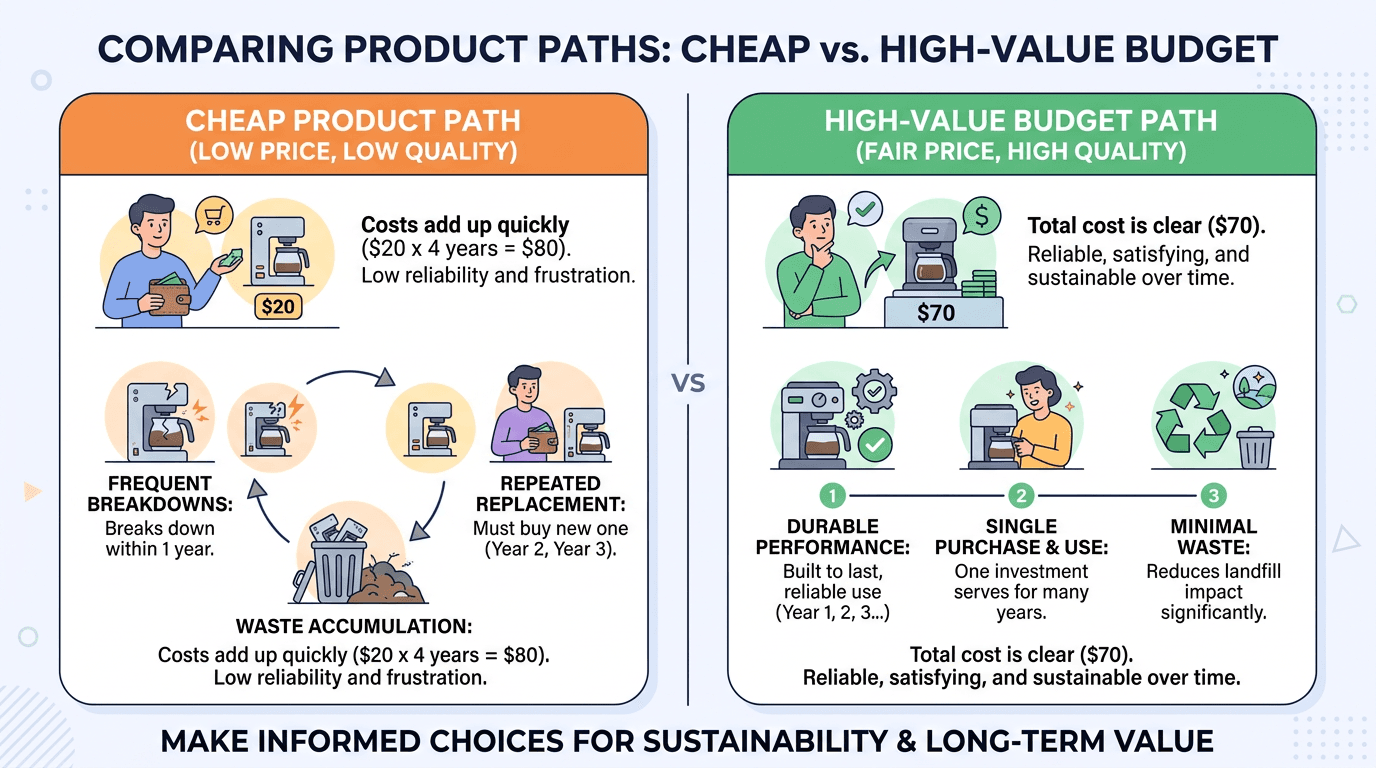
However, navigating the budget landscape requires a nuanced understanding of what we call Strategic Frugality. It is essential to distinguish between a "budget" item and a "cheap" item. To illustrate this, we often look to the "Vimes 'Boots' Theory of Socioeconomic Unfairness," popularized by author Terry Pratchett. The theory posits that a rich person can spend $50 on a pair of boots that last ten years, while a poor person can only afford $10 boots that last a season. After ten years, the poor person has spent $100 on boots and still has wet feet.
The "Best Budget" picks of the modern era aim to break this cycle. We are looking for the "Buy It For Life" (BIFL) entry points—products that are priced affordably but built with the structural integrity to last. This involves looking for specific markers of quality:
- User-Replaceable Parts: Can the battery be swapped? Are the ear pads replaceable?
- Material Honesty: Using high-quality plastics (like PBT or Polycarbonate) instead of "faux" materials that peel and crack.
- Software Longevity: In tech, a budget device is only a good value if it receives security updates for more than a year.
The HootFinds Buyer’s Guide: The Best Budget Heroes of 2024
When we curate "Best Budget" lists, we aren't looking for the absolute lowest price on the market. We are looking for the products that offer the highest "Joy-to-Dollar Ratio." These are the tools and gadgets that feel like you’ve cheated the system.
1. The Smartphone Value King:
While the flagship "Ultra" phones push the $1,200 mark, the Pixel 7a offers the exact same "Tensor G2" processor and the legendary Google computational photography for a fraction of the cost. It proves that a great camera is now a software problem, not just a hardware one.
2. The Audiophile's Secret:
In the world of In-Ear Monitors (IEMs), the Aria has become a cult legend. Using a liquid crystal polymer diaphragm, these earbuds provide a frequency response that rivals wired headphones costing five times as much. They represent the "democratization of hi-fi."
3. The Kitchen Workhorse:
Perhaps the ultimate "budget" item. For less than the price of a pizza, you can buy a tool that is virtually indestructible, naturally non-stick, and will literally last for generations. It is the antithesis of the disposable non-stick pans that end up in landfills every two years.
4. The Powerhouse Accessory:
Anker has mastered the art of "Premium Budget." This power bank offers 140W fast charging and a smart digital display—features usually reserved for professional-grade gear—at a price point that makes it an essential for any traveler.
5. The Smart Home Entry Point:
Wyze disrupted the entire security industry by proving that a weather-resistant, 1080p camera with color night vision didn't need to cost $200. It is a masterclass in stripping away the "Brand Premium" to deliver pure utility.
The Psychology of Choice: How to Identify a Hidden Gem
Becoming a master of the budget market requires a shift in how you process information. Marketing departments are trained to sell you on "The Dream"—the lifestyle you will lead if you buy their $3,000 espresso machine. To find the budget alternative, you must focus on "The Utility."
When evaluating a potential purchase, ask yourself: "What is the primary engine of this product's value?"
- For a vacuum, it’s the motor's suction power (PA) and filtration (HEPA).
- For a monitor, it’s the panel type (IPS/OLED) and color accuracy (sRGB coverage).
- For clothing, it’s the fiber content (100% wool vs. polyester blends) and the weight of the fabric.
By ignoring the "lifestyle" branding and focusing on the technical specifications, you can often find unbranded or "white-label" products that perform identically to the market leaders. This is particularly true in the world of "Chifi" (Chinese Hi-Fi) and specialized home goods, where the factory that produces the name-brand item often sells a nearly identical version under their own label.
The Future of Budget: Sustainability and the "Second-Hand Premium"
As we look toward the future, the definition of "Best Budget" is expanding to include the pre-owned and refurbished markets. In a world where tech has plateaued, a two-year-old flagship is often a better "budget" buy than a brand-new entry-level device.
The rise of platforms that offer certified refurbished goods with warranties has removed the risk from the second-hand market. Buying a "Renewed" in 2024 is perhaps the smartest budget move a student or professional can make. It offers a build quality and battery life that no brand-new $500 Windows laptop can touch. This "Circular Economy" approach is not only better for the wallet but essential for the planet, as it extends the lifecycle of high-quality materials.
Conclusion: The New Status Symbol is Savvy
We are entering a period where the ultimate status symbol is no longer how much you spent, but how much you saved while maintaining a high standard of living. The "Best Budget" philosophy is an exercise in mindfulness; it requires us to look past the shiny veneer of advertising and see products for what they truly are: tools to enhance our human experience.
When we choose the over a more expensive, bass-boosted fashion headphone, or a mouse over a $150 "Pro" alternative, we are making a statement. We are stating that we value engineering over hype, longevity over trendiness, and substance over style. In the end, the best budget choice isn't about being cheap—it's about being free. It's about freeing up your capital for the things that truly matter: experiences, education, and the freedom to choose your own path without being tethered to the treadmill of luxury consumption. The high-value revolution is here, and it’s never looked better.
Common Questions
🤔
Frequently Asked Questions
What is the best value for money in high-demand consumer electronics today?▼
The best value for money today focuses on mid-range options that deliver core performance, durability, and aesthetics close to flagship levels. These 'best budget' picks leverage the 90% rule, delivering most of the experience at a fraction of the price. By prioritizing proven reliability and practical features over premium embellishments, you get a satisfying, long-lasting experience without overpaying for marginal gains.
How does the 90% rule apply to premium tech purchases?▼
The 90% rule suggests you can obtain about 90% of flagship functionality for roughly 40% of the price. This implies that the remaining 10% of extra performance often costs a premium Tax with diminishing utility. For most users, that extra performance yields little measurable happiness, making budget-friendly options the smarter choice.
Why are 'best budget' products often smarter than flagship models?▼
Because most people benefit more from reliable core performance than from rare, expensive features. Best budget picks eliminate the gadgetry that doesn’t move the needle and emphasize durability, value, and a refined user experience. This aligns with the diminishing returns principle and the idea of strategic acquisition rather than status signaling.
What should I look for when choosing a 'best budget' item?▼
Look for a balance of core performance, build quality, and aesthetics that meet your actual needs, not what marketing promises. Favor proven mid-range specifications, favorable reviews, durable materials, and a warranty that reduces risk. Prioritize products that deliver long-term satisfaction, minimal bloatware, and a design that ages well with you.