Blog3/3/2026
Personal AI: The Second Brain and Your Digital Partnership
9 mins Read
The Briefing
Quick takeaways for the curious
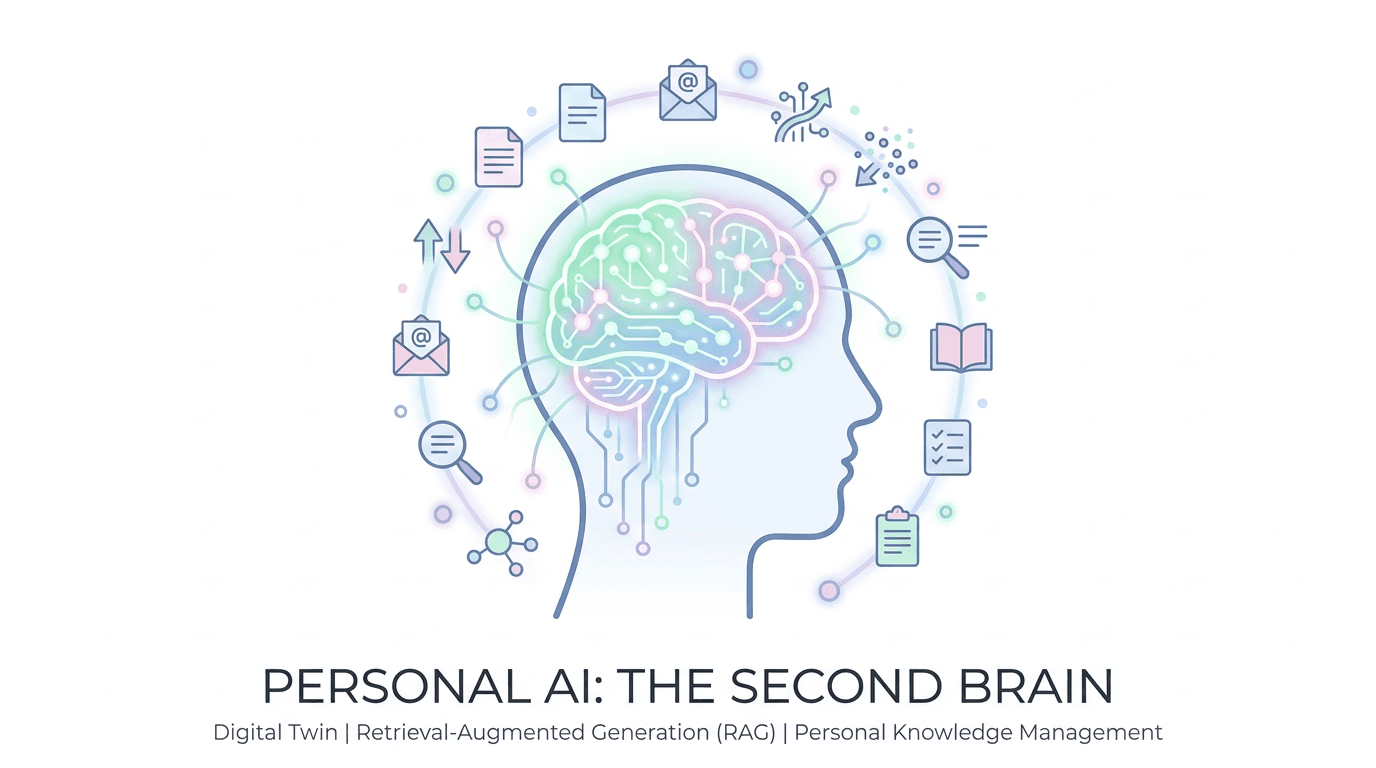
Personal AI marks a shift from using tools to engaging in a collaborative partnership that understands your context and history, effectively functioning as a digital twin that extends your cognitive capabilities.
Context is the new currency: Retrieval-Augmented Generation (RAG) enables AI to access your private data—emails, notes, PDFs—so its responses are grounded in your own materials rather than generic web results.
The 'second brain' unlocks higher cognitive bandwidth by summarizing, prioritizing, and surfacing signals, reducing information overload and freeing you to focus on strategic work.
The architecture creates a feedback loop: the more you interact with your Personal AI, the more aligned and useful it becomes, reinforcing a productive human–machine partnership.
While powerful, Personal AI requires thoughtful governance around privacy, data control, and ethical use to avoid over-reliance and data leakage, ensuring trust and safety.
The Digital Alter Ego: Navigating the Era of Personal AI and the Rise of the Second Brain
We are currently living through the most significant shift in human cognition since the invention of the printing press. For decades, our relationship with technology was transactional: we gave a command, and the machine executed a task. We typed into Google, and it returned a list of links. We opened a spreadsheet, and it crunched the numbers. But the tide has turned. We are moving away from the era of "computing" and into the era of "partnership." The rise of Personal AI represents the transition from a tool that we use to an extension of who we are. It is no longer about searching the vast, impersonal ocean of the internet for answers; it is about cultivating a digital ecosystem that understands your context, remembers your history, and anticipates your needs. This is the "Second Brain"—a sophisticated, silicon-based auxiliary to our biological minds that promises to solve the modern crisis of information overload. We aren't just using AI; we are co-evolving with it, reclaiming our mental bandwidth from the mundane to focus on the monumental.
The Architecture of Intimacy: Why Context is the New Currency
To understand why Personal AI is a quantum leap beyond the chatbots of yesteryear, we have to look at the concept of contextual awareness. Traditional AI, like the early versions of Siri or Alexa, operated on a "stateless" model. Every time you spoke to them, it was like meeting a stranger with amnesia; they had no memory of your previous preferences, your ongoing projects, or your unique rhetorical style. Modern Personal AI, powered by Large Language Models (LLMs) and a technique called Retrieval-Augmented Generation (RAG), changes the game entirely.
RAG allows an AI to "hook" into your private data—your emails, your meeting notes, your PDFs, and your past conversations—without requiring the entire model to be retrained. It creates a personalized library that the AI can browse in milliseconds before it answers your question. When you ask a Personal AI, "What did I decide about the marketing budget?" it isn't guessing based on general internet data; it is looking at the specific transcript of your Zoom call from last Tuesday.
"The true promise of AI isn't in its ability to write a poem about a toaster in the style of Shakespeare; it’s in its ability to know that you’re low on sleep, have a high-stakes meeting at 9 AM, and need your briefing notes summarized into three bullet points before you finish your first coffee." — Dr. Aris Thorne, Cognitive Technologist
This intimacy creates a feedback loop. The more you interact with your Personal AI, the more "aligned" it becomes with your cognitive patterns. This is the birth of the Digital Twin, a version of your intellect that can sort through the noise of the world and present only the signal that matters to you.
The Hardware Revolution: Moving AI from the Screen to the Senses
While software like ChatGPT and Claude have dominated the headlines, the most exciting frontier of Personal AI is happening in the physical world. We are witnessing the "de-screenization" of technology. For the last fifteen years, the smartphone has been our primary interface, but it is a jealous mistress—it demands our eyes, our thumbs, and our constant posture of "the head-down tilt."
The new wave of AI hardware aims to integrate intelligence into our sensory stream. Devices like AI-powered glasses and wearable pendants are designed to be "ambient." They see what you see and hear what you hear, acting as a cognitive overlay on reality. This is the shift from Reactive AI (where you go to a device to ask a question) to Proactive AI (where the device offers information because it senses you need it).
For instance, imagine wearing smart glasses that recognize a person walking toward you at a conference. Before they reach you, the AI whispers their name and the last topic you discussed into your ear via bone conduction. This isn't science fiction; it’s the immediate trajectory of the wearable market. According to recent market analysis, the AI wearable sector is expected to grow at a CAGR of 25% through 2030, as users seek ways to stay connected without being tethered to a glowing rectangle in their palms.
The "Second Brain" and the End of Forgetting
One of the most profound applications of Personal AI is in the realm of Memory Augmentation. Human memory is notoriously fallible; we are subject to the "forgetting curve," where information is lost over time if it isn't actively reviewed. Personal AI acts as a permanent, searchable record of your life.
By using tools that record and transcribe our daily interactions—with our permission—we create a searchable database of our own lives. This has radical implications for productivity. The average knowledge worker spends nearly 20% of their work week just searching for internal information or tracking down colleagues to get answers. Personal AI reduces this to seconds.
However, this "End of Forgetting" comes with a philosophical price. If we no longer need to remember the details of our lives because our AI does it for us, what happens to our biological capacity for synthesis? The answer lies in the "Augmentation Paradox": by outsourcing the storage of information, we free up the brain's prefrontal cortex for higher-level creative thinking and complex problem-solving. We are effectively upgrading our internal hardware by offloading the storage to the cloud.
The HootFinds Buyer’s Guide: Curating Your AI Ecosystem
The market is currently flooded with "AI-powered" gadgets, but only a few truly deliver on the promise of a personalized digital companion. To build your own Personal AI stack, you need a mix of foundational software and ambient hardware. Here are our top recommendations for the current landscape:
- The Foundation: remains the gold standard for general intelligence. With its "Memory" feature and the ability to create custom GPTs, you can feed it your style guides, project histories, and personal preferences to make it a true assistant.
- The Search Engine of the Future: is essential for those who need real-time data synthesis. Unlike traditional search, it cites its sources and builds a narrative around your query, making it the perfect research partner for the Second Brain.
- The Ambient Visionary: are the most "normal" looking entry into AI hardware. With integrated cameras and speakers, they allow you to ask AI about things you are looking at in real-time, from translating a menu to identifying a plant in the wild.
- The Meeting Whisperer: is a powerhouse for anyone whose life is lived in Zoom or Google Meet. It doesn’t just transcribe; it identifies action items and summarizes sentiment, ensuring that no detail of a conversation is ever truly lost.
- The Personal Knowledge Base: is an AI-native workspace that organizes itself. Instead of you worrying about folders and tags, Mem uses AI to connect your notes, emails, and calendar events automatically based on their content.
- The New Hardware Frontier: is a pocket-sized companion designed to use your apps for you. Using a Large Action Model (LAM), it aims to move past the "chat" interface and actually perform tasks like booking an Uber or ordering a pizza through a simple voice interface.
The Privacy Paradox: The Cost of Being Known
We cannot talk about Personal AI without addressing the elephant in the room: Data Sovereignty. For an AI to be truly "personal," it must know your secrets. it must have access to your private thoughts, your financial records, and your intimate conversations. This creates a massive security surface area.
The current debate in the tech world is centered on Local vs. Cloud AI. Most powerful models currently run in the cloud, meaning your data travels to a server owned by a corporation. However, we are seeing a massive push toward "Edge AI"—models small enough to run directly on your laptop or phone without an internet connection.
- Data Encryption: Look for services that offer end-to-end encryption.
- Opt-out Clauses: Ensure you are using platforms that do not use your personal data to train their "global" models.
- The Right to Delete: A true Second Brain should be under your total control, including the "kill switch" that wipes its memory.
As the venture capitalist Marc Andreessen famously noted, "Software is eating the world," but in this new era, AI is eating software. The privacy concerns are real, but for many, the trade-off—a 10x increase in personal productivity and a near-perfect memory—is becoming too enticing to ignore.
The Future of the Human-AI Symbiosis
We are moving toward a future where "Personal AI" will simply be called "My AI." It will be as ubiquitous as a smartphone and as essential as an education. We will see the rise of AI Agents—autonomous entities that don't just talk to us, but talk to other AIs on our behalf. Your AI will negotiate with a restaurant's AI to get you a table, or coordinate with your doctor's AI to sync your health data.
This isn't just about efficiency; it's about the democratization of expertise. Personal AI provides everyone with a world-class research assistant, a creative director, and a life coach, available 24/7 for the price of a monthly subscription. The barrier to entry for complex tasks is collapsing.

The ultimate goal of Personal AI is not to replace human intelligence, but to amplify it. By stripping away the friction of daily life—the scheduling, the searching, the summarizing—we are left with more time to do what humans do best: innovate, empathize, and create. The digital alter ego is not a replacement for the self; it is the scaffolding upon which the next version of the self will be built.
As we stand on this threshold, the question isn't whether you will adopt a Personal AI, but how you will choose to train your digital shadow. Will it be a mere secretary, or will it be the catalyst for your greatest work yet? The silicon is ready; the context is yours to provide.
Common Questions
🤔
Frequently Asked Questions
What exactly is 'Personal AI' and how does it differ from traditional AI tools?▼
Personal AI is an intimate partner that knows your context and history, effectively acting as a digital twin that extends your cognitive reach. Unlike traditional tools that return generic internet results, it uses retrieval-augmented generation (RAG) to access your private data and tailor insights from your own documents, emails, and notes. This shift changes the relationship from merely using a tool to collaborating with a system that anticipates needs. It emphasizes memory, personalization, and continual alignment with your goals.
How does Retrieval-Augmented Generation enable a 'Second Brain' and why is context important?▼
RAG lets the AI fetch relevant fragments from your private data sources in real time, so its answers are grounded in your actual materials rather than generic web content. This contextual grounding creates a more reliable 'second brain' that can summarize, organize, and support decisions based on your history. Context is crucial because it reduces cognitive load and minimizes irrelevant results, leading to faster, more accurate, and actionable outputs.
What steps should a user take to start adopting Personal AI responsibly?▼
Begin by inventorying data sources you want the AI to access and set clear boundaries about privacy and sensitivity. Enable privacy controls, opt-in data sharing, and prefer local processing where possible. Pilot with low-risk tasks to validate accuracy and adjust prompts and memory settings. Regularly review outputs and update preferences to prevent drift and preserve control.
What potential risks should individuals and organizations consider with Personal AI and Digital Twins?▼
Risks include privacy and security concerns from linking private materials to an AI agent. There is potential for misalignment or bias if the system infers conclusions from your data incorrectly. Overreliance can erode critical thinking and create single points of failure. Effective governance, transparency, data controls, and ongoing evaluation are essential to mitigate these risks.