Blog3/1/2026
Circadian Lighting at Home: Resync Your Everyday Rhythm
8 mins Read
The Briefing
Quick takeaways for the curious
Modern homes often bathe occupants in midday-like, blue-rich LED light, which disrupts natural circadian signals and can suppress melatonin, contributing to sleep fragmentation and poorer metabolic health.
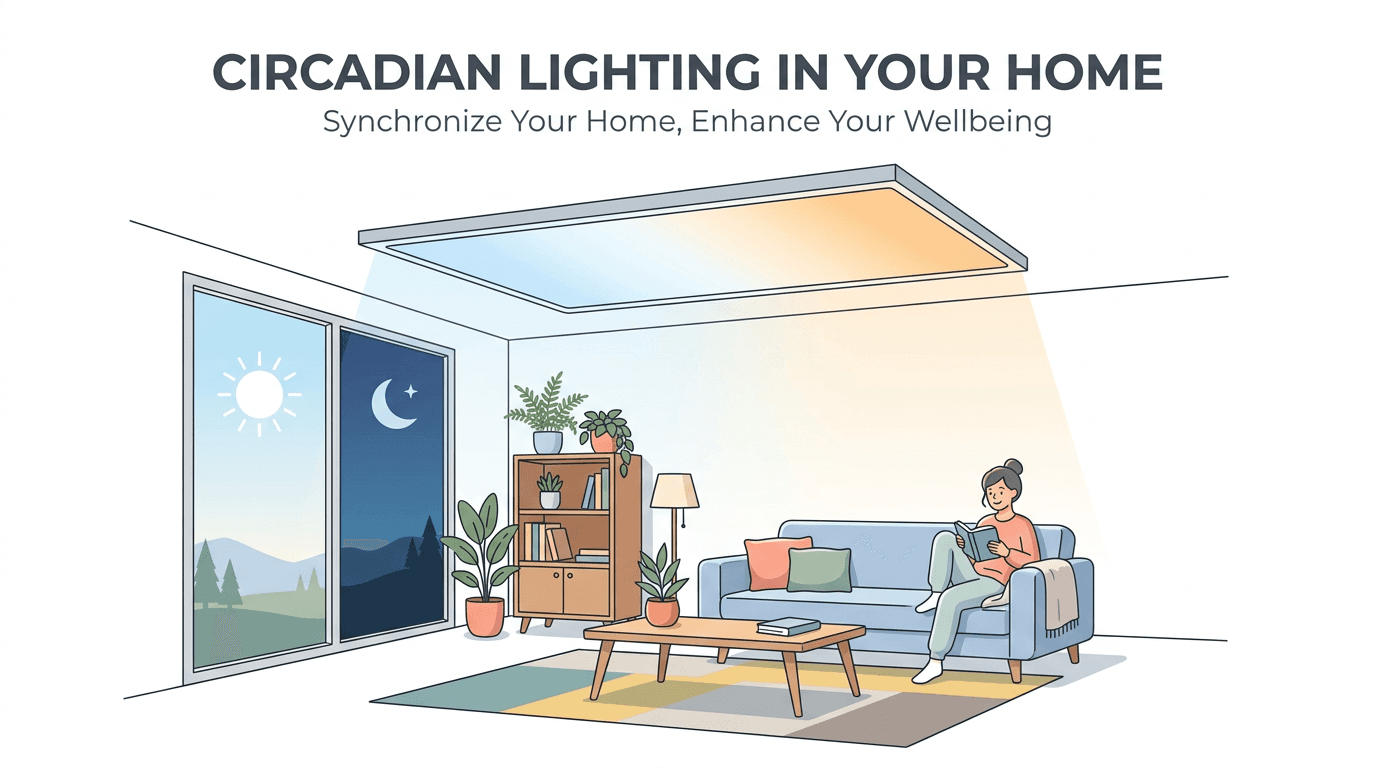
Circadian lighting combines photobiology and smart-home automation to progressively mimic sunrise to sunset indoors, helping the brain interpret day and night more accurately.
The brain's master clock (the SCN) relies on intrinsically photosensitive retinal ganglion cells (ipRGCs) containing melanopsin to detect blue light and regulate hormones; mis-timed indoor lighting can hijack this system.
Understanding the Kelvin scale enables you to choose lighting that is warm in the evening (roughly 2700K) and cooler during the day (roughly 5000K–6500K) to support alertness and sleep.
Practical steps include using tunable white LEDs, scheduling gradual color shifts throughout the day, and reducing intense blue light at night to restore sleep quality and metabolic health.
The biological sun has set on the modern home, replaced by a static, high-glare "perpetual noon" that our DNA simply doesn't recognize. For nearly all of human history, our internal rhythms were dictated by the rising and falling of the sun—a shifting masterpiece of warm ambers, brilliant blues, and deep oranges. Today, however, we spend roughly 90% of our lives indoors, bathed in the sterile, unyielding flicker of standard LEDs and the high-energy visible (HEV) blue light of our ubiquitous screens. This "light junk food" has created a state of chronic biological jetlag, confusing our brains, suppressing our sleep hormones, and fracturing our metabolic health. But a sophisticated movement in home wellness is seeking to fix this. Enter Circadian Lighting, a marriage of advanced photobiology and smart-home automation that seeks to re-sync our indoor environments with the celestial cycles of the natural world. By installing lighting that "breathes" with the day, we aren't just decorating a room; we are recalibrating our very biology.
The Master Clock: Why Your Brain Craves the Sun
To understand the necessity of circadian lighting, we have to look at the tiny bundle of 20,000 neurons sitting in your hypothalamus called the Suprachiasmatic Nucleus (SCN). This is your body's master clock. It regulates everything from your body temperature and hunger to the release of cortisol and melatonin. However, the SCN doesn't have a window; it relies on signals from the eyes to know what time it is. Specifically, it listens to a specialized group of cells in the retina called intrinsically photosensitive Retinal Ganglion Cells (ipRGCs). These cells contain a photopigment called melanopsin, which is exquisitely sensitive to blue light wavelengths (around 480nm).
When the sun is high and the sky is blue, these cells tell the brain to flood the body with cortisol, boosting alertness and heart rate. As the sun dips and the light shifts toward the warmer, redder end of the spectrum, the signal wanes, allowing the pineal gland to begin the "melatonin onset" process. In a standard modern home, this process is hijacked. By blasted ourselves with "daylight-balanced" 5000K LED bulbs at 9:00 PM, we are effectively telling our brains that it is midday in the Sahara. This suppresses melatonin production by as much as 85%, leading to delayed sleep onset and reduced REM cycles.
"Light is the most important environmental signal that the brain receives. It doesn’t just allow us to see; it acts as a drug that regulates our mood, our cognitive performance, and our long-term health." — Dr. Steven Lockley, Neuroscientist and Circadian Rhythms Expert.
The Kelvin Scale: Decoding the Language of Light
In the world of circadian lighting, we measure the "color" of light using the Kelvin (K) scale. Understanding this scale is the first step toward reclaiming your biological rhythm. A traditional incandescent bulb sits at about 2700K, emitting a warm, yellowish glow. The midday sun is a crisp 5000K to 6500K, packed with the blue light necessary for focus.
The goal of a Circadian Lighting Home is to create a dynamic shift throughout the day:
- Morning (6 AM – 9 AM): Transitioning from warm amber (2000K) to a bright, cool white (4000K) to signal the body to wake up and stop melatonin production.
- Midday (9 AM – 3 PM): High-intensity, blue-rich light (5000K-6500K) to maximize cognitive performance, mood, and alertness.
- Late Afternoon (3 PM – 6 PM): A gradual softening and warming of the light back toward 3000K.
- Evening (6 PM – Bedtime): Low-intensity, warm light (below 2700K) with minimal blue light content to facilitate the "wind-down" phase.

Engineering the "Sun" Indoors: The Practical Setup
Implementing a circadian system doesn't necessarily require a multi-million dollar architectural overhaul. The "biohacking" of your home lighting can be achieved through three main tiers of technology:
- Smart Bulbs with "Circadian Mode": These are the easiest entry point. These bulbs contain multiple sets of LEDs (warm and cool) that blend together to reach specific color temperatures. Many modern apps now include a "follow the sun" feature that automates the transition based on your local GPS coordinates.
- Smart Switches and Dimmers: If you prefer your existing fixtures, smart dimmers like those from Lutron can be programmed to lower light intensity as the evening progresses. While intensity isn't the same as color temperature, lowering the Lux (the amount of light hitting a surface) is a critical secondary signal for the brain.
- Dedicated Task Lighting: For those who work in windowless offices or basement "caves," high-output circadian lamps can provide the necessary 10,000 Lux of "light therapy" in the morning to anchor the rhythm for the rest of the day.
Research published in the Journal of Biological Rhythms indicates that even a weekend of "natural light only" (camping) can reset a person's master clock. By bringing that cycle indoors, we are essentially mimicking the "camping effect" while maintaining the comforts of modern life.
The HootFinds Buyer’s Guide to Circadian Tech
When building your circadian sanctuary, you want hardware that offers a wide Kelvin range (ideally 2000K to 6500K) and high color rendering index (CRI) so that colors look natural, not washed out. Here are our top picks for transforming your space:
- The Gold Standard: – This is the most mature ecosystem on the market. Their "Hue Bridge" allows for seamless "Natural Light" scenes that automatically transition your entire home throughout the day without you lifting a finger.
- The Designer’s Choice: – This is a masterpiece of engineering. It tracks your local daylight and adjusts its color temperature and brightness every 60 seconds. It also features a unique 360-degree glow for evening relaxation.
- The Best for Retrofitting: – If you have beautiful chandeliers or recessed lighting that you don't want to replace with smart bulbs, Lutron’s system allows you to automate the intensity of your light, which is half the circadian battle.
- The Creative Powerhouse: – While often seen as "gamer" lights, Nanoleaf’s "Circadian Lighting" feature is excellent. Their panels can fill a wall with high-intensity blue-rich light during the workday and shift to a soft, candle-like flicker at night.
- The Budget Biohacker: – An affordable way to add "under-glow" or "behind-the-TV" bias lighting that follows a schedule. Use these to create a low-level "amber path" for late-night bathroom trips that won't wake your brain up.
- The Dedicated Therapy Tool: – Perfect for the morning "anchor." Spending 20 minutes in front of this 10,000 Lux lamp while drinking your morning coffee can significantly improve seasonal mood shifts.

Reclaiming Your Sleep Architecture
One of the most profound benefits of circadian lighting is the improvement in Sleep Architecture—the structural transition between light, deep, and REM sleep. When we are exposed to bright blue light late at night, our brain stays in a state of high-frequency "Beta" waves. By switching to warm, dim lighting two hours before bed, we encourage the brain to shift into "Alpha" and "Theta" waves, the precursors to deep sleep.
Furthermore, the "Morning Blue" is just as important as the "Evening Amber." A study by the Lighting Research Center found that office workers who were exposed to high levels of circadian-effective light in the morning fell asleep faster at night and reported lower levels of stress and depression. It's a virtuous cycle: better light during the day leads to better sleep at night, which leads to better energy the following morning.
Key Tips for Implementation:
- Avoid the "Overhead Glare": In the evening, turn off overhead lights and use floor lamps. Light hitting the bottom half of the retina (from above) is more stimulatory than light hitting the top half (from below).
- The Red Room: For the hour before sleep, try shifting your smart bulbs to a deep red. Red light has the least impact on melatonin suppression.
- Automate the "Wake-Up": Set your bedroom lights to slowly brighten over 30 minutes before your alarm goes off. This "dawn simulation" helps clear adenosine (the sleepiness chemical) from your brain.

The Future of the Indoor Environment
We are currently witnessing a shift in how we define "home." It is no longer just a shelter; it is becoming a proactive wellness tool. As we move further into the 21st century, the integration of bio-metric feedback—where your smart watch tells your light bulbs that you had a poor night's sleep and need a "blue light boost" in the morning—will become the norm.
Circadian lighting is a quiet acknowledgment that we are biological creatures trapped in a digital world. It is an olive branch extended to our ancient DNA, promising that even if we cannot spend all day in the sun, we can at least bring the sun's wisdom indoors. By aligning our homes with the rhythms of the earth, we aren't just seeing better; we are living better. The next time you flip a switch, ask yourself: is this light feeding my focus, or is it starving my sleep? The answer might be the most important health decision you make today.
Common Questions
🤔
Frequently Asked Questions
What is circadian lighting and why is it important for sleep and health?▼
Circadian lighting is lighting designed to align indoor illumination with the body's natural day-night cycles. It uses dynamic color temperature and intensity to mimic sunrise and sunset, signaling the brain's circadian clock. When light cues match the time of day, melatonin production can follow its normal rhythm, supporting better sleep and daytime performance. In contrast, constant cool, blue-rich light can confuse the system and undermine health.
How does blue light from LEDs and screens affect melatonin and sleep?▼
Blue light, detected by ipRGCs containing melanopsin, signals the brain that it is daytime. Exposure to high-blue content, especially in the evening, can suppress melatonin production and delay sleep onset. The article notes that bright 5000K lighting at night can reduce melatonin by up to about 85%, disrupting REM and overall sleep quality. Reducing evening blue light or using warmer lighting helps restore the natural sleep-wake rhythm.
What lighting temperatures should I use at different times of day?▼
During the day, cooler, blue-rich light in the 5000–6500K range supports alertness and cognitive performance. In the evening, switch to warmer light around 2700–3000K to support melatonin onset. If possible, implement gradual shifts to avoid abrupt changes and keep cues aligned with the sun's cycle.
How can I implement circadian lighting in an existing home on a budget?▼
Start with a few tunable-white LED fixtures or smart bulbs that can adjust color temperature. Use a smart lighting system or timer to gradually shift from cool daytime light to warm evening light. Limit night exposure by dimming lights and reducing blue content after sunset. Pair with available natural daylight where possible to reinforce circadian cues.