
Blog2/28/2026
Digital Nomad Taxes: Navigating Residency and Risks
10 mins Read
The Briefing
Quick takeaways for the curious
Tax residency is the controlling factor for nomads: where you legally belong, not just where you physically stay, drives your liability through tests like center of vital interests, permanent home, and economic ties.
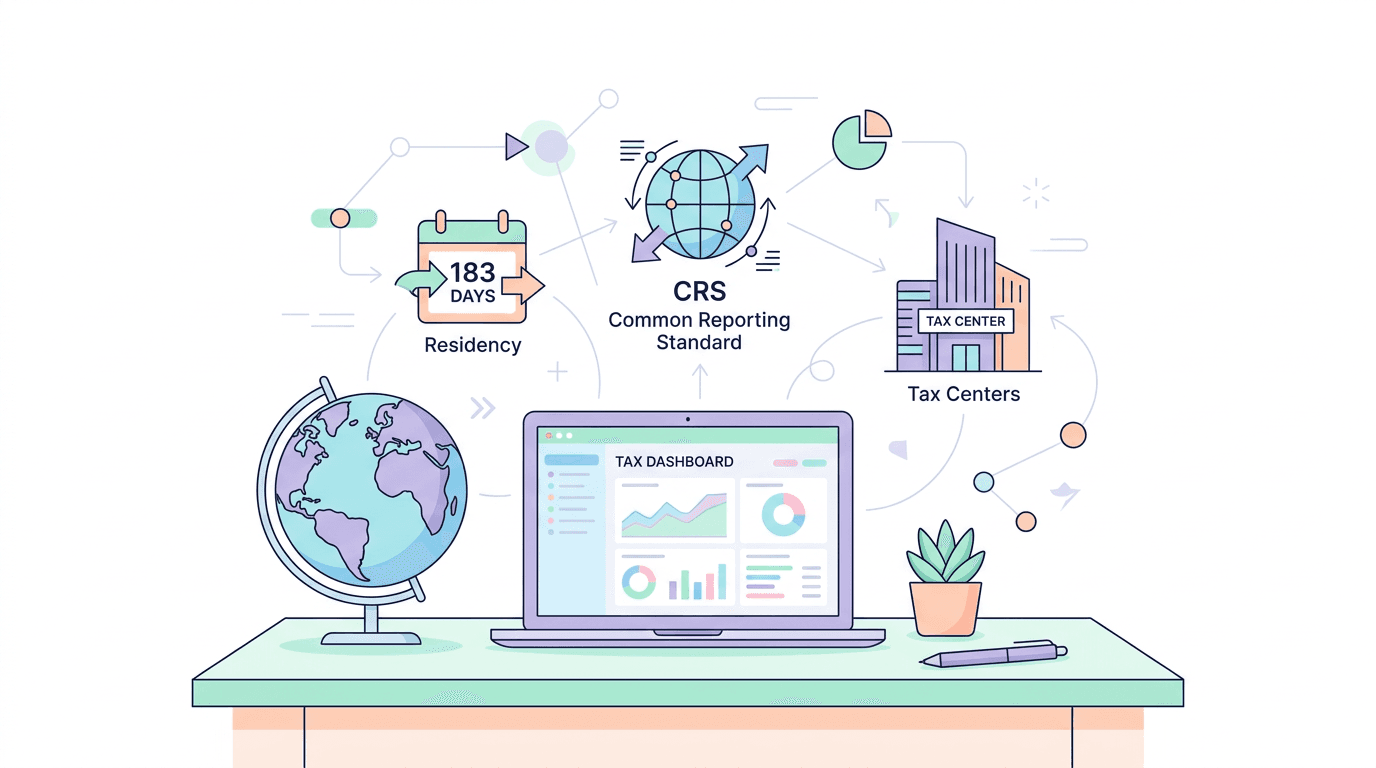
The 183-day rule is common but not universal, and many jurisdictions apply additional tests that can redefine your tax status based on where you have a home, employment, or significant economic interests.
The CRS information-sharing regime means banks and financial accounts abroad can reveal residency, making the 'tax-free nomad' mindset increasingly risky.
Relying on the 'Tax Ghost' strategy can backfire, leading to back taxes, penalties, or even litigation if you haven't properly established a tax status in any country.
A proactive approach—tracking days, mapping ties, consulting local experts, and planning with potential treaty benefits—helps preserve mobility while staying compliant.
The Residency Paradox: Navigating the High-Stakes World of Digital Nomad Taxes
The dream is perpetually sold in high-saturation Instagram reels: a MacBook Pro resting on a reclaimed teak table, a condensation-beaded coconut to the left, and a turquoise Balinese horizon to the right. This is the "laptop lifestyle," a promise of geographical arbitrage where you earn in a strong currency like the USD or Euro while spending in a weaker one, effectively hacking your way into a luxury lifestyle for the price of a mid-western studio apartment. But as the tan lines fade and the reality of a three-month visa run sets in, a shadow begins to loom over the palm trees—the taxman. For the better part of a decade, digital nomads operated in a legal gray zone, a fiscal "no man’s land" where being "homeless" in the eyes of the law meant being invisible to the revenue service. Those days are officially over. As governments worldwide catch up to the remote work revolution, the "tax-free" nomad life is transitioning from a clever loophole into a potential legal minefield. Understanding your tax obligations isn't just about being a "good citizen"; it’s about protecting your mobility and ensuring that your financial freedom doesn't come with a side of federal litigation.
The Myth of the "Tax-Free" Nomad: Why Nowhere is Not an Answer
The most dangerous misconception in the nomad community is the idea that if you don't stay in one country for more than 183 days, you don't owe taxes anywhere. This is often referred to as the "Tax Ghost" strategy, and while it sounds logically sound, it frequently ignores the concept of Tax Residency. Most countries operate on a residency-based system, but they also have "exit" hurdles and "center of vital interest" tests. If you leave your home country but don't establish a legal tax residency elsewhere, your home country may still claim you as a resident by default.
The 183-day rule is the most famous metric—stating that if you spend more than half a year in a jurisdiction, you are a tax resident there—but it is far from the only one. Many European and Asian nations use a "permanent home" or "economic interests" test. If you still have a bank account, a driver’s license, or a storage unit in London or Toronto, the authorities can argue that your "center of life" remains with them, regardless of how many stamps are in your passport.
"Tax authorities are no longer looking just at where you are, but where you 'belong.' In a digitized world, your digital footprint—from credit card transactions to Netflix logins—creates a trail of residency that is becoming harder to obscure." — Vincenzo Villamena, International Tax Expert.
This shift is driven largely by the OECD’s Common Reporting Standard (CRS), an information-gathering initiative where over 100 countries automatically exchange financial account information. If you open a bank account in Georgia or Mexico, that data is likely being shared back to your home country. The era of "don't ask, don't tell" in international finance is effectively dead.

The American Exception: Citizenship-Based Taxation
If you carry a blue U.S. passport, the rules of the game are fundamentally different—and significantly more complex. The United States is one of only two countries (the other being Eritrea) that practices citizenship-based taxation. This means that as long as you are a U.S. citizen or Green Card holder, the IRS claims a right to a piece of your global income, regardless of where you live, where you work, or where your clients are located.
However, the U.S. government does provide tools to prevent double taxation, the most significant being the Foreign Earned Income Exclusion (FEIE). For the 2024 tax year, the FEIE allows qualifying expats to exclude up to $126,500 of their foreign-earned income from U.S. federal income tax. To qualify, you must pass either the Physical Presence Test (being outside the U.S. for 330 full days in a 12-month period) or the Bona Fide Residence Test (proving you are a resident of another country for an entire tax year).
- Self-Employment Tax: Even if you exclude your income via FEIE, if you are a freelancer or business owner, you likely still owe the 15.3% Social Security and Medicare tax.
- FBAR and FATCA: If the total value of your foreign bank accounts exceeds $10,000 at any point during the year, you must file a Foreign Bank and Financial Accounts (FBAR) report. Failure to do so can result in penalties that dwarf the actual balance of the account.
- The Foreign Tax Credit (FTC): If you are living in a high-tax country (like Spain or Germany) and paying local taxes, the FTC allows you to reduce your U.S. tax bill dollar-for-dollar based on what you’ve already paid to the foreign government.
Navigating these regulations requires more than just a spreadsheet; it requires a proactive strategy that begins before you even book your one-way flight.
The Rise of Digital Nomad Visas: A Double-Edged Sword
In the wake of the pandemic, dozens of countries—from Portugal and Estonia to Barbados and Indonesia—launched "Digital Nomad Visas" (DNVs). These were designed to lure high-spending remote workers to bolster local economies. While these visas offer the legal right to stay for a year or more, they come with specific fiscal implications.
Some countries, like Costa Rica, offer a DNV that explicitly exempts holders from local income tax on foreign-sourced earnings. Others, like Spain, have introduced the "Beckham Law" equivalent for nomads, allowing them to be taxed at a flat rate (around 24%) rather than the progressive income tax brackets that can climb as high as 45-50%.
However, the "local source" trap is real. If you are in Thailand on a nomad visa and you take on a local Thai client, that income is almost certainly taxable in Thailand. Furthermore, if your "remote" work involves managing a team or physical assets within the host country, you may inadvertently create a "Permanent Establishment," triggering corporate tax obligations for your home-based company.

The Tech Stack of the Compliant Nomad: A Buyer’s Guide
Managing taxes across multiple borders is a data management problem. You cannot rely on a shoebox full of receipts when you are moving cities every three weeks. The modern nomad needs a "Financial Fortress"—a suite of tools that automate tracking, currency conversion, and document storage.
To build a compliant and efficient remote operation, consider integrating these essential tools into your workflow:
- : The gold standard for small business accounting. Its ability to handle multi-currency transactions is vital when you are earning in USD but paying for "business expenses" in Pesos or Baht.
- : Traditional banks will kill you with wire fees and mid-market exchange rate markups. Wise allows you to hold 40+ currencies and provides local bank details in the US, UK, EU, and Australia, making it easier to receive payments without the "international" friction.
- : Security is a tax issue. Accessing sensitive financial portals or banking apps over unsecured cafe Wi-Fi is a recipe for identity theft. A dedicated IP via NordVPN ensures you can access your home-country financial services without triggering "suspicious activity" lockdowns.
- : This app is a lifesaver for the "Physical Presence Test." It uses GPS and receipt scanning to create a bulletproof log of where you were and what you spent, which is essential if you ever face an IRS audit regarding your FEIE eligibility.
- : Use this as your "Digital Tax Vault." Create a notebook for each tax year and clip every digital invoice, flight confirmation, and visa stamp. When your accountant asks for proof of travel three years from now, it’s all in one searchable place.
- : While software helps with tracking, education helps with strategy. Keeping a current guide on international tax law ensures you aren't caught off guard by new OECD regulations or treaty changes.
Mastering Geographical Arbitrage: The Long Game
The ultimate goal of the digital nomad is not just to see the world, but to build wealth through Geographical Arbitrage. This is the practice of earning in a high-value economy while living in a low-cost one. However, the true "win" happens when you combine this with tax optimization.
If you earn $100,000 a year living in San Francisco, your take-home pay after federal taxes, state taxes, and a $4,000-a-month rent might be $35,000. If you earn that same $100,000 while living in a nomad-friendly hub like Da Nang, Vietnam, and you qualify for the FEIE, your tax burden drops significantly. Your cost of living might only be $2,000 a month for a luxury lifestyle. Your "wealth-building" capacity shifts from $5,000 a year to $60,000 a year.
Key Concepts for Optimization:
- Tax Treaties: Always check if your home country has a "Double Taxation Treaty" with your host country. These treaties dictate which country has the "first right" to tax your income.
- Totalization Agreements: These are "Social Security Treaties" that prevent you from paying into two different national social security systems at the same time.
- The 330-Day Rule: For U.S. nomads, this is the "Golden Rule." Missing this by even 24 hours because of a delayed flight or a family emergency can cost you tens of thousands of dollars in excluded income. Always build in a 10-day "buffer."

The Future of Fiscal Citizenship
We are moving toward a world of "A La Carte" citizenship. The rise of E-Residency programs (pioneered by Estonia) and the proliferation of "Golden Visas" suggest that in the future, your tax residency will be a choice rather than an accident of birth. However, this choice comes with the responsibility of meticulous record-keeping.
As artificial intelligence begins to assist tax authorities in flagging inconsistencies in cross-border filings, the "DIY" approach to nomad taxes is becoming increasingly risky. The most successful nomads view tax preparation not as a year-end chore, but as a continuous part of their business operations. They understand that the price of global mobility is eternal vigilance over their digital and fiscal footprint.
In the end, the "laptop on the beach" lifestyle is only sustainable if you have the "ledger in the cloud" to back it up. By embracing the complexity of international tax law rather than hiding from it, you can transform your nomadic journey from a temporary escape into a permanent, wealth-generating reality. The goal isn't to pay zero taxes; it’s to pay exactly what you owe, and not a cent more, while leveraging the world’s various legal frameworks to fund your freedom.
Final Thought: If you could live anywhere in the world, where would you go if you knew your tax strategy was bulletproof? The world is open, but the gates are guarded by forms, filings, and fine print. Master them, and the world is truly yours.
Common Questions
🤔
Frequently Asked Questions
Do digital nomads owe taxes if they stay in a country for less than 183 days?▼
Not necessarily. The 183-day rule is common but not universal; many countries apply additional residency tests such as permanent home, center of vital interests, and economic ties that can make you a tax resident even with fewer days. You may owe taxes or have reporting obligations in your home country or where your income is sourced, regardless of where you physically stay. The idea of a truly tax-free nomad life is increasingly risky as authorities tighten rules.
What does tax residency mean for digital nomads and what tests might apply besides the 183-day rule?▼
Tax residency is the status that triggers tax obligations in a country, often determined by where you belong rather than where you travel. Beyond the 183-day rule, jurisdictions may assess permanent home, center of vital interests, economic ties, or even where you maintain key life anchors like a driver's license or bank accounts. The landscape is evolving, with CRS data flows increasing the likelihood that your ties are detected across borders. Understanding each country’s rules is essential for staying compliant as you move.
How does the OECD CRS affect nomads and their banking information?▼
CRS is an information-sharing framework under which more than 100 countries automatically exchange financial account data. If you open a bank account abroad or hold financial assets in another jurisdiction, those records can be reported back to your home country. This increases the risk that your residency status and tax obligations are inferred even if you intended to stay nomadic. Proactive disclosure and proper planning become important to avoid surprises.
What practical steps can I take to stay compliant and protect my mobility as a digital nomad?▼
Track and document your days in each jurisdiction, along with your ties such as a home base, employment, and family. Consult a qualified tax adviser who understands digital nomad scenarios and local rules, especially around residency and double tax treaties. Develop a mobility plan that aligns with residency requirements and potential treaty benefits, and review it regularly as visa rules and tax laws evolve. This proactive approach helps preserve mobility while reducing the risk of penalties.