Blog2/22/2026
Your Posture is Ruining Your Life: 5 Biological Hacks to Rewire Your Nervous System
5 minutes Read
The Briefing
Quick takeaways for the curious
Posture directly influences psychology; upright stances foster positive memories while slumping encourages depressive thoughts.
Neuroception is your nervous system's subconscious safety scanner that operates faster than conscious thought.
Chronic pain is often a 'software glitch' called Nociplastic Pain, which can be treated through Somatic Tracking.
Nasal breathing engages the 'vagal brake' to reduce stress, whereas mouth breathing signals danger.
Rhythmic movements like rocking and floor sitting provide biological signals of safety to the brain.
Your Body is a Remote Control: 5 Surprising Ways Your Posture and Nerves Dictate Your Reality
Have you ever felt trapped in a cycle of stress or chronic pain despite "doing everything right"? You meditate, you eat well, and you attempt to maintain a positive mindset, yet your body remains on high alert. This disconnect often stems from a fundamental misunderstanding of our biology: we treat our minds and bodies as separate entities.
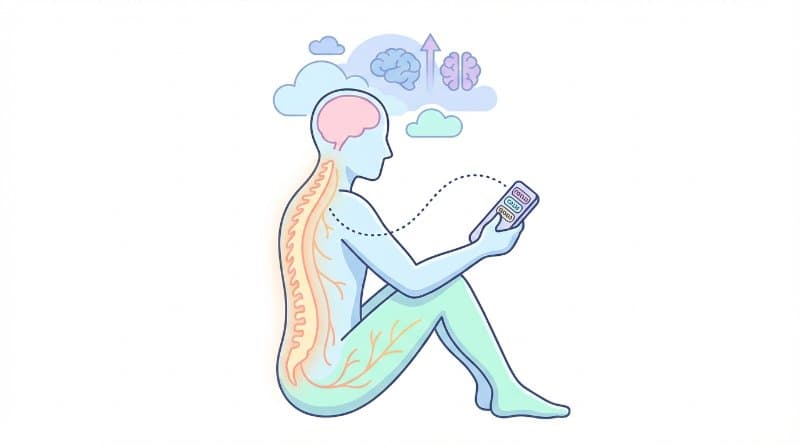
In reality, your physical state is the "software" running your mental and emotional "hardware." We are moved by the invisible puppet strings of the Autonomic Nervous System (ANS)—specifically the vagus nerve, the 10th cranial nerve and the primary conductor of our parasympathetic system. To truly shift how we feel, we must master our "physical inhabitance"—the way we sit, stand, and occupy our bodies in every given moment.
Here are five high-impact insights on how to take the remote control back from your nervous system and realign your reality.
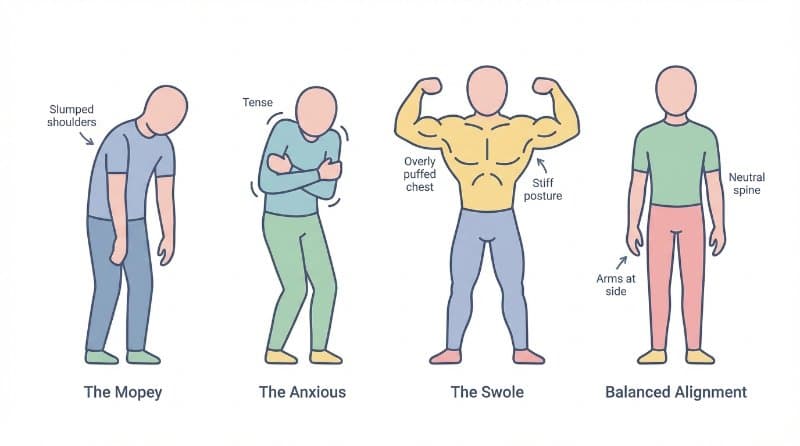
1. Your Posture is Actually Your Autobiography
Your movement is a literal expression of how you think and feel. Research from Ohio State University revealed that postural position directly shapes self-belief; when hunched over, participants were significantly more likely to distrust their own positive traits. Furthermore, researchers at San Francisco State University found that an upright posture serves as a gateway to uplifting memories, while a slumped position makes it easier to access depressive thoughts.
When we are misaligned, we suffer from "parasitic tension"—an energetic drain caused by holding imbalanced patterns. For example, modern Westerners often possess a high-amplitude "S-curve" spine, whereas children and non-industrialized cultures often maintain a longer, more stable "J-shaped" spine. Reclaiming your alignment is a neurochemical act that signals safety and confidence to your cells. To support this alignment during long work hours, consider investing in a proper seat .
Postural Archetypes and their Biological Costs:
- The Mopey: Characterized by collapsed shoulders, medial rotation, and a tucked pelvis. Associated with "disconnect" and high-kyphosis (rounded upper back).
- The Anxious: Marked by shoulders pulled toward the ears (braced for impact) and shallow chest breathing. This keeps the nervous system in a state of high alert.
- The Swole: A chest-puffed, dominant stance. While it looks "strong," it typically involves flared ribs and reduced abdominal integrity, which forces the body into a perpetual state of "fight-or-flight" bracing.
"The way you walk through a room is the way you walk through life." — Ida Rolf
2. "Neuroception"—The Sixth Sense You Didn't Know You Had
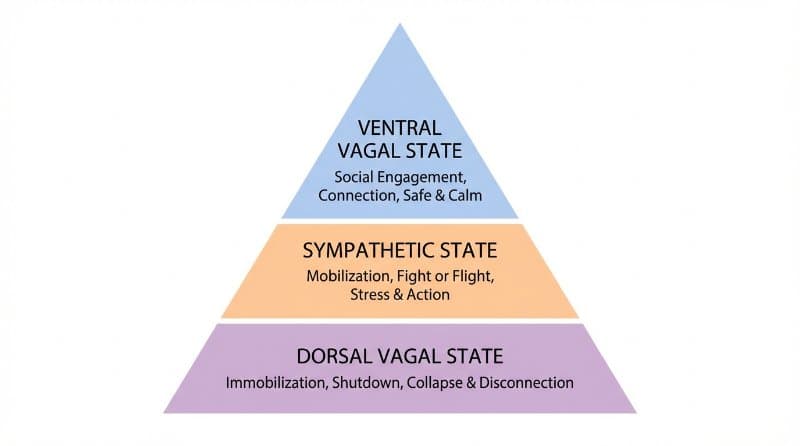
Coined by Dr. Stephen Porges in the Polyvagal Theory, "neuroception" is the subconscious process by which our neural circuits distinguish safety from danger. This happens below the level of conscious thought—before your thinking brain even registers a threat.
While the Polyvagal Theory is sometimes debated among neuroanatomists regarding its evolutionary claims, it remains a powerful clinical framework for trauma recovery. It describes a hierarchy: the Ventral Vagal system (pro-social, calm) and the Dorsal Vagal system (shutdown, immobilization). When your "vagal brake" releases, you are dropped into a state of panic or freeze. You cannot "think" your way out of a shutdown because your body has already decided the hardware must be hijacked for survival.
3. Chronic Pain as a "Software Glitch" (Nociplastic Pain)
Chronic pain is often not the result of "hardware" damage (tissue injury) but a "software" glitch known as Nociplastic Pain. This occurs when the brain’s alarm system becomes sensitized, overreacting to neutral sensations.
To fix this, we use Somatic Tracking, a brain-retraining technique designed to decrease the perceived threat. You can practice this while lying comfortably on a in a quiet room.
The Three Pillars of Somatic Tracking:
- Mindfulness: Nonjudgmentally observing the sensation (e.g., "I feel a warm, tingling sensation").
- Safety Reappraisal: Using evidence to prove the brain is misinterpreting data. Ask: Does the pain move? Does it go away during joyful activities?
- Positive Affect Induction: Shifting into a state of ease using humor, music, or lightness.
Instructional Tip: Safety Reappraisal
Talk to your brain like a "scared pet" in a thunderstorm. Use a soothing, confident tone: "I am safe. These sensations are just a misinterpretation. No damage is being done."
Caution: The Ulterior Motive
The Somatic Tracking Guide warns that tracking with the specific goal of reducing the pain can actually increase the threat. You must track with neutral curiosity. If you are watching the pain just to see if it goes away, your nervous system interprets that hyper-vigilance as danger.
4. The "Remote Control" of Nasal Breathing
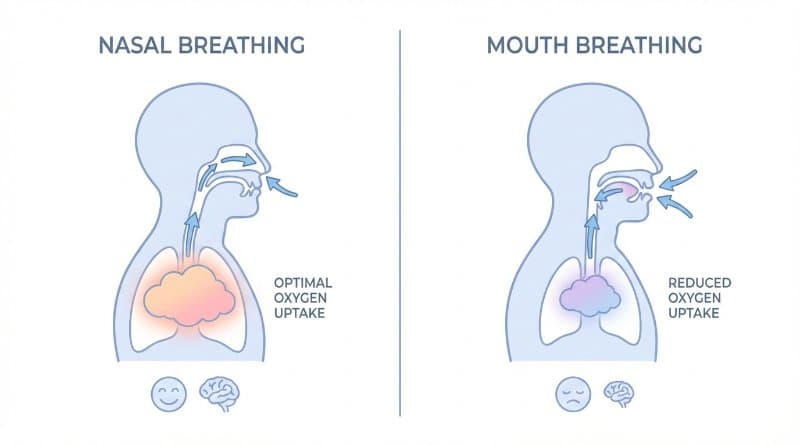
If the nervous system is an engine, breath is the tuning mechanism. Mouth breathing is biologically "expensive"—it signals sympathetic stress and can even lead to dental deformities and jaw collapse. Nasal breathing, however, engages the "vagal brake" and optimizes oxygen transfer. Many biohackers now use at night to ensure nasal breathing during sleep.
A key metric for your respiratory health is the BOLT score (Body Oxygen Level Test). To calculate your score:
- Take a regular inhale and a regular exhale through your nose.
- Pinch your nose with your fingers to hold your breath.
- Time how long it takes until you feel the first definite urge to breathe.
- Release and resume normal nasal breathing. (If your first breath is a gasp, you held it too long).
A score below 25 seconds suggests sub-optimal breathing and chronic over-breathing. You can verify your oxygen saturation levels using a to see how your breathing affects your blood chemistry. By using a Gears System—matching the intensity of your breath to your output—you maintain control over your internal chemistry.
"If you know the art of breathing you have the strength, wisdom, and courage of ten tigers." — Chinese Proverb
5. The "Ancient Magic" of Rhythmic Safety
Primitive movements like rocking and floor sitting are the ultimate "bio-hacks" for emotional regulation.
The Rocking Chair: Rocking activates the vestibular system in the inner ear, sending a signal of "predictability" to the brain. Because the movement is steady and repetitive, the brain concludes that nothing threatening is happening. Critically, this rhythmic, bilateral movement supports hemispheric integration, enhancing communication between the left and right sides of the brain for better emotional processing. A classic is not just furniture; it is a therapeutic tool.
Floor Sitting: "Archetypal Postures of Repose"—such as squatting, kneeling, or cross-legged sitting—act as natural tuning mechanisms. These positions provide "wordless reassurance" to the nervous system. Sitting on the floor requires you to move through greater ranges of motion to sit and stand, which rehydrates the joints and recirculates lymphatic fluid, acting as a natural age-proofing strategy. Using a can make this practice more accessible.
Conclusion: Becoming the Architect of Your Alignment
Your physical state is not a passive reflection of your life; it is the architect of it. Practices of regulation—whether it is a minute of nasal breathing, five minutes of floor sitting, or the neutral observation of a pain signal—are not a denial of reality; they are an anchor within it. By changing your shape, you change your state.
A Final Ponderable: How is the way you are inhabiting your body right now shaping the thoughts you will have five minutes from now?
Common Questions
🤔
Frequently Asked Questions
What is the BOLT score in breathing?▼
The BOLT (Body Oxygen Level Test) score measures your tolerance to carbon dioxide buildup. It is the time in seconds you can comfortably hold your breath after a normal exhale before feeling the first urge to breathe. A score below 25 seconds indicates sub-optimal respiratory health.
How does posture affect mental health?▼
Research indicates that posture acts as a feedback loop for the brain. An upright posture facilitates access to positive memories and self-confidence, while a slumped posture makes it easier to access depressive thoughts and feelings of distrust.
What is Somatic Tracking for chronic pain?▼
Somatic Tracking is a brain-retraining technique for Nociplastic pain. It involves observing pain sensations with mindfulness and safety reappraisal—viewing the pain as a 'false alarm' rather than tissue damage—to lower the nervous system's threat level.