
Blog2/17/2026
Forget Apps: 4 Secrets of the 2026 'Ring of Fire' Eclipse & DIY Astronomy
5 minutes Read
The Briefing
Quick takeaways for the curious
The February 17, 2026, Solar Eclipse will be an annular 'Ring of Fire' visible primarily from Antarctica.
Amateur astronomers can calculate celestial events using the 'recipe method' with a standard scientific calculator.
Using spreadsheets instead of calculators increases prediction precision from a 10-minute margin to within one minute.
The 2026 eclipse is part of the Saros 121 cycle, which spans from 944 AD to 2206 AD.
The Clockwork Above Us
In an age where we outsource our curiosity to smartphone push notifications, the celestial dance has often been reduced to a passive "check the app" experience. We wait for a digital alert to tell us when to look up, treating the movement of the heavens like a software update rather than the result of the grand, predictable geometry of orbital mechanics.
On February 17, 2026, the solar system will once again perform one of its most striking maneuvers: a solar eclipse. While the modern enthusiast might simply refresh a tracking map, there is a profound, technical satisfaction in realizing that the "magic" of the cosmos is entirely accessible through simple logic. By treating astronomical prediction as a series of manageable procedures, anyone with a scientific calculator can move from being a spectator to an active participant in mapping the clockwork above.
1. The Exclusive "Ring of Fire" Over Antarctica
The event on February 17, 2026, is an annular eclipse, a phenomenon often referred to as a "Ring of Fire." This occurs when the Moon’s apparent diameter is slightly smaller than the Sun’s, failing to cover the solar disc entirely and leaving a brilliant annulus of light.
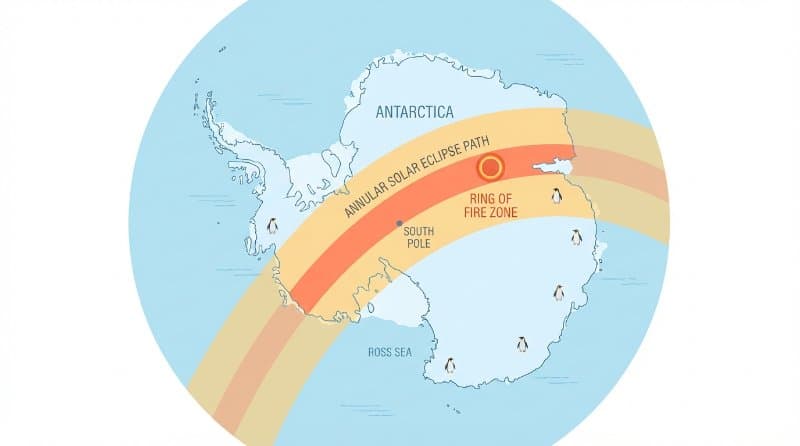
From a technical standpoint, the 2026 event is a masterclass in orbital timing. The eclipse occurs roughly 6.8 days after apogee (the point where the Moon is furthest from Earth) and 7.5 days before perigee (the point where it is closest). Because the Moon is currently trending toward the further reaches of its elliptical path, its apparent size is insufficient to block the Sun completely.
While the partial shadows will sweep across the Southern Hemisphere, the true "annularity" is a remarkably exclusive engagement. The path of the antumbral shadow is restricted almost entirely to the Antarctic continent. To view this safely, you would need specialized gear like solar viewing glasses .
Eclipse Visibility Data:
- Concordia Station (Antarctica): Annular (92.46% Coverage)
- Port-aux-Français (Kerguelen): Partial (83.57% Coverage)
- Port Louis (Mauritius): Partial (31.64% Coverage)
- Cape Town (South Africa): Partial (5.19% Coverage)
2. The "Recipe" Method of Astronomy
We often assume that predicting the movement of the stars requires a PhD or a supercomputer. However, as Peter Duffett-Smith and Jonathan Zwart demonstrate in Practical Astronomy with your Calculator or Spreadsheet , even the most intimidating concepts—coordinate transformations, ecliptic longitude, or geocentric parallax—can be distilled into straightforward "recipes."
This approach bridges the gap between the layperson and the astrophysicist by focusing on the essential factors of a calculation while ignoring minor "corrections for this and that" that only professionals require. With a standard scientific calculator capable of handling trigonometric functions (sine, cosine, and tangent), the amateur can determine the Moon’s position to within one-fifth of a degree and sunrise/set times within one minute.
As the authors describe their philosophy:
"You use it just as you would a recipe book in the kitchen – follow the recipe and produce a delicious dish!"
By following these step-by-step instructions, you aren't just doing math; you are executing a "hack" for the universe, using the same fundamental logic that once guided ancient navigators.
3. The Precision Paradox: Calculators vs. Spreadsheets
When mapping the heavens manually, there is a "precision gap" that reveals the power of modern personal computing. Using manual recipes and a handheld calculator, an amateur can find the time of a moonrise to within roughly 10 minutes—a feat that feels nearly miraculous when performed with pencil and paper.
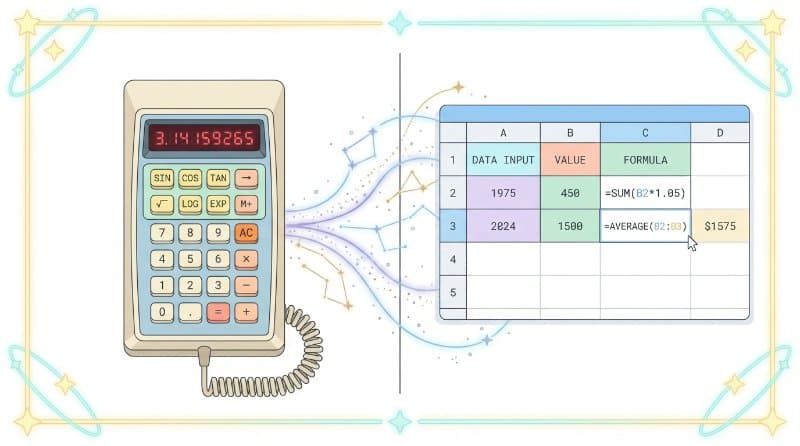
However, the "Scientific Sophisticate" knows how to close this gap. By translating those same recipes into a spreadsheet on a powerful laptop , you gain access to eight-byte double precision. This higher resolution allows the software to handle the minute variables of celestial phenomena with far greater granularity. The 10-minute uncertainty of the manual method narrows significantly, bringing results to within a one-minute margin of error.
This paradox offers a unique tech-blogger satisfaction: whether you choose the tactile process of a handheld device or the high-precision efficiency of a spreadsheet, you are using the same tools usually reserved for taxes or schoolwork to master the mechanics of the Solar System.
4. The 1,200-Year Rhythm of Saros 121
The February 2026 eclipse is not a random occurrence; it is a single pulse in a vast astronomical lineage known as Solar Saros 121. To understand Saros 121 is to witness the "cosmic evolution" of a shadow.
The 2026 event is member 61 of 71 in a series that repeat every 18 years and 11 days. The history of this specific series illustrates the shifting geometry of our orbit:
- The Origins: It began as a modest partial eclipse on April 25, 944 AD.
- The Total Phase: For centuries, it produced total eclipses, reaching a peak duration of 6 minutes and 20 seconds in 1629, before the series transitioned out of totality in 1809.
- The Current Annular Phase: We are now in the midst of its annular era. The 2026 event will have a duration of 140 seconds, nearly matching the series' maximum annularity of 147 seconds which will occur in 2044.
- The Conclusion: The clockwork will finally wind down with a final partial eclipse on June 7, 2206 AD.
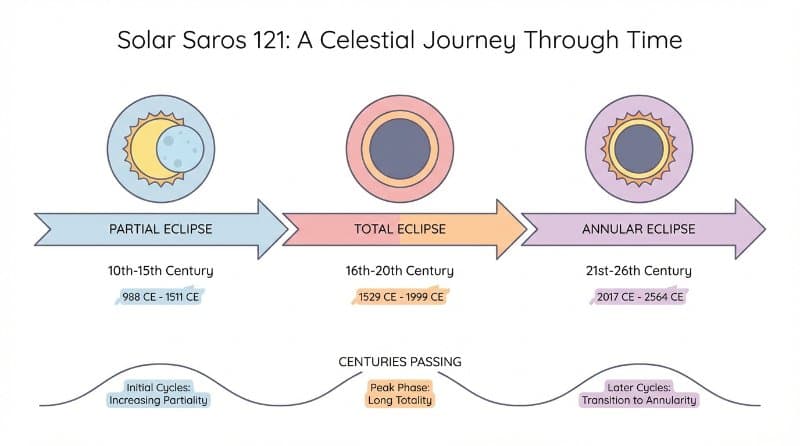
When you observe the "Ring of Fire" in 2026, you are participating in a 1,200-year rhythm—a member of an astronomical lineage that began in the early Middle Ages and will continue long after we are gone.
Reclaiming the Stars
On February 17, 2026, the Moon will once again slide across the face of the Sun. Whether you find yourself in the frozen silence of Concordia Station or the bustling streets of Cape Town, the event serves as a reminder that the laws governing the universe are transparent and knowable.
By looking beyond the convenience of an app and attempting to calculate these movements yourself, you reclaim a piece of human history that connects us to the very first stargazers. If you could calculate the movement of the heavens on a device that fits in your pocket, how would it change your perspective on the world below?
Common Questions
🤔
Frequently Asked Questions
When is the next annular solar eclipse in Antarctica?▼
The next major annular solar eclipse visible from Antarctica will occur on February 17, 2026.
What is the difference between a manual calculation and a spreadsheet for astronomy?▼
Manual calculations with a scientific calculator usually have a margin of error of about 10 minutes, while spreadsheets offer double-precision computing that narrows the error margin to roughly one minute.
What is Solar Saros 121?▼
Solar Saros 121 is a specific cycle of solar eclipses that repeats every 18 years and 11 days, containing 71 events between the years 944 AD and 2206 AD.