Blog2/21/2026
Stop Stretching: 5 Somatic Hacks to Reset Your Nervous System Instantly
5 minutes Read
The Briefing
Quick takeaways for the curious
Anxiety is often a physical event stuck in the body, requiring 'bottom-up' processing rather than just mental reasoning.
Traditional stretching can trigger a 'stretch reflex' that increases tension; somatic pandiculation is more effective for releasing muscles.
The hips act as an 'emotional junk drawer,' storing trauma and stress that can be released through mindful movement.
You can reset your nervous system in under 60 seconds using Vagus Nerve stimulation techniques like humming or the Butterfly Hug.
Somatic movement focuses on internal sensation ('moving for feels') rather than external appearance, restoring body sovereignty.
Beyond the Stretch: 5 Surprising Ways Your Body Holds the Key to Anxiety Relief
Have you ever noticed your shoulders slowly creeping toward your ears during a stressful workday, or realized your jaw has been clenched so tight your teeth ache? Perhaps you feel wound like a spring, or like you’re holding your breath without even realizing it. If you’ve felt like your body is a house you’re no longer welcome in, you’re not alone. This is "survival mode"—a state where the nervous system remains braced for a threat that isn't in the room. To combat this physical stress, many people turn to ergonomic solutions to support their posture, but the root cause often lies deeper.
In the world of mind-body wellness, we call the body as experienced from within the Soma. While traditional "top-down" talk therapy or high-intensity exercise have their place, they often fall short because stress isn't just a thought—it is a physical event "stuck" in your tissues. To find true relief, we have to stop trying to out-think our anxiety and start speaking the language of the body.
1. Your Mind Follows Your Body: The "Bottom-Up" Revolution
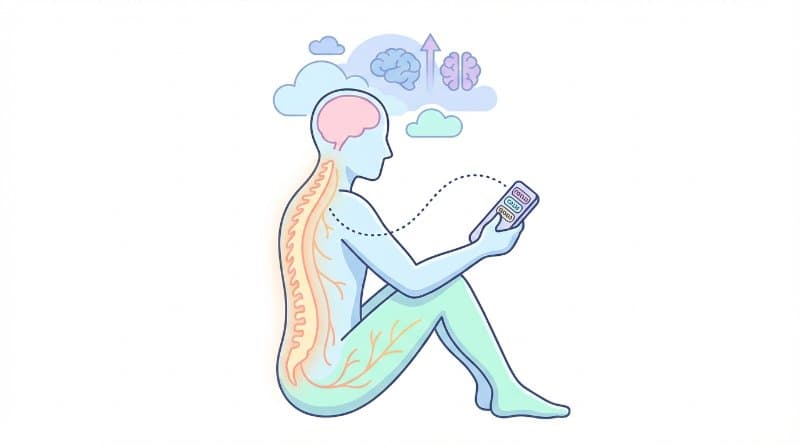
Most of us were raised to believe that if we change our thoughts, our feelings will follow. This is "top-down" processing. But when your nervous system is stuck in a loop of dysregulation, your brain stem is flooded with signals to stay braced. You cannot simply "reason" your way out of a racing heart.
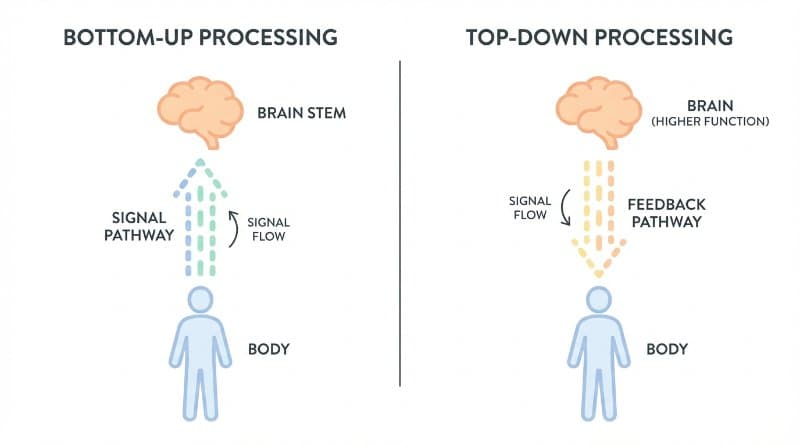
The revolution lies in "bottom-up" processing—starting with the body to calm the mind. This hinges on Interoception, our internal sense of what is happening inside us. By turning your attention inward to track subtle sensations like warmth, pulsing, or weight, you send a direct message to your brain that the "emergency" is over. Instead of viewing your body as an obstacle to overcome, you begin to see it as a powerful ally. When you provide the body with physical evidence of safety, the mind has no choice but to follow suit.
2. Why Traditional Stretching Might Be Backfiring
It’s a common instinct: your back feels tight, so you reach for your toes. However, science tells us that traditional stretching might actually be making you tighter. Deep within your muscles are receptors called spindle cells. When a muscle is pulled too far or too fast, these cells trigger a "stretch reflex"—a monosynaptic message sent to the spinal cord that immediately tells the muscle to re-contract to prevent a tear. This is why forcing a stretch on a standard mat can sometimes lead to more stiffness the next day.
To truly change the resting level of a muscle, we must move beyond the spinal cord (Level 3 reflex) and engage the motor cortex (Level 1 voluntary control). This is the "pharmacy" between your ears that can "turn the light switch off" on chronic tension. The tool for this is Pandiculation: a slow, voluntary contraction followed by an even slower, conscious release. It’s like a "reset button" for your muscular system.
The key to regaining voluntary control over chronically tight muscles is to use very slow, conscious movements that engage the nervous system in a relearning process.
3. The "Emotional Junk Drawer" in Your Hips
In somatic yoga, we often refer to the hips as the "emotional junk drawer" of the body. As noted in the seminal work The Body Keeps the Score , our muscles—particularly the psoas and hip flexors—brace as a form of protection during trauma or chronic stress. We store heavy emotions there that we aren't yet ready to process.
Using the SIBAM model (Sensation, Image, Behavior, Affect, and Meaning), we understand that an emotion is often "coupled" with a physical sensation. When you move through deep hip-opening somatic sequences, you aren't just lengthening a muscle; you are "uncoupling" dissociated experiences. This is why it is so common for tears, laughter, or a sudden sense of relief to bubble to the surface. Your mat is a safe space for this processing—a place where you can finally let go of what you’ve been carrying.
4. You Can "Reset" Your Nervous System in 60 Seconds
Somatic work is beautifully portable. You don’t need a studio or a 90-minute block of time to practice "emotional hygiene." You can signal safety to your vagus nerve—the main highway of your parasympathetic nervous system—using simple micro-resets that take less than a minute. Sitting on a comfortable surface or cushion can enhance these practices.
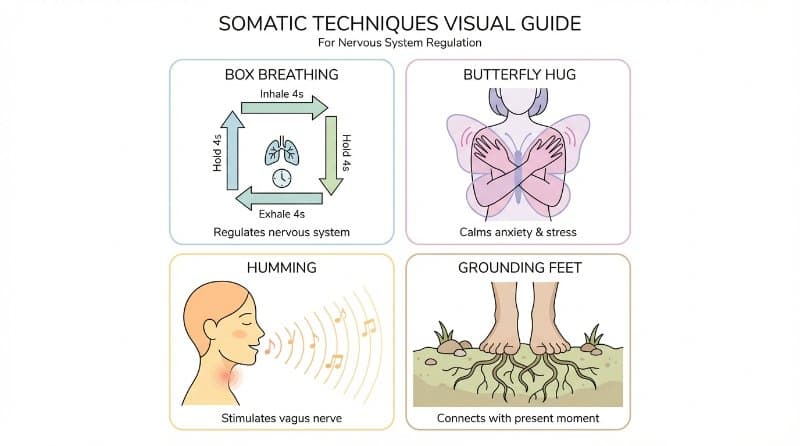
- The Box Breath: Inhale for 4 counts, hold for 4, exhale for 4, and hold the empty lungs for 4. This rhythm is a fast-track to a calmer state.
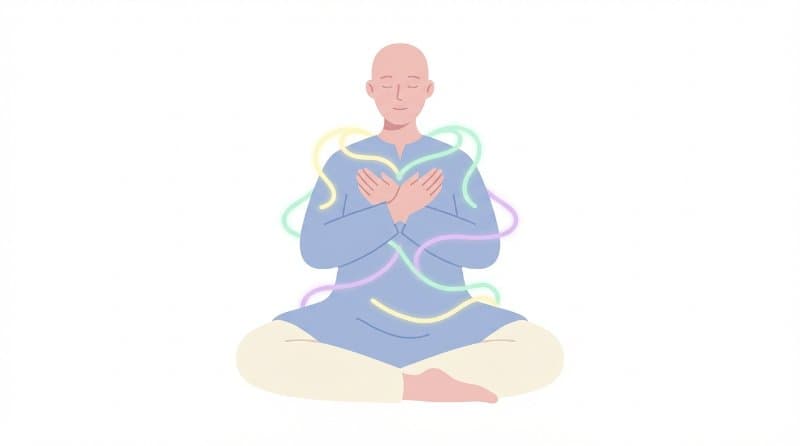
- The Butterfly Hug: Cross your arms over your chest and slowly, alternately tap each shoulder for one minute while breathing deeply.
- Vagus Nerve Humming: Softly hum a tune or a simple "Om." The internal vibrations stimulate the vagus nerve, acting as a direct "safety signal" to the brain.
- Grounding Through the Feet: Stand and feel all four corners of your feet (the heel, outer edge, inner ball, and big toe) pressing into the floor. Notice the solidity of the earth beneath you to immediately center a racing mind. Some people find that wearing minimal footwear helps improve this sensory connection with the ground.
5. Reclaiming Joy Through "Moving for Feels"
The ultimate shift in somatic movement is moving away from "moving for looks" (performance) and toward "moving for feels" (sensation). This restores a sense of sovereignty over your own body. By practicing pandiculation—that yawn-like, intuitive stretch and release—you aren't just "working out"; you are retraining your nervous system to exist in a state of R.E.A.D.Joy:
- Relief from chronic tension.
- Ease of movement.
- Awareness of internal signals.
- Dignity in your physical presence.
- Joy in the simple act of being.
Somatic movement works like a reset button, signalling safety to your nervous system and teaching the body how to let go.
From Survival to Sovereignty
If you have felt trapped in a cycle of anxiety, remember: you are not broken. You may simply be stuck in a physiological pattern of survival. Your motor cortex is a 24/7 internal pharmacy capable of generating its own relief through mindful, slow movement. By listening to the subtle cues of your Soma, you move from being managed by your stress to having sovereignty over your well-being.
Take a moment right now: where is your body holding tension, and what would happen if you gave it permission to let go just 10% more?
Common Questions
🤔
Frequently Asked Questions
What is the difference between somatic movement and regular stretching?▼
Regular stretching often passively pulls muscles, which can trigger a protective contraction reflex. Somatic movement, or pandiculation, involves a slow, voluntary contraction followed by a conscious release to retrain the nervous system and relax muscles at the neurological level.
How does the 'bottom-up' approach help with anxiety?▼
The 'bottom-up' approach starts with the body rather than the mind. By using physical sensations and movements to signal safety to the brain stem, you can calm the nervous system more effectively than trying to 'think' your way out of anxiety.
Can somatic exercises really release emotional trauma?▼
Yes, according to theories like the SIBAM model and experts like Bessel van der Kolk, emotions are often coupled with physical tension. Somatic exercises help 'uncouple' these sensations, allowing stored emotions to surface and be processed safely.