
Blog2/17/2026
Loud Budgeting: Why Saying 'No' Is The Ultimate Financial Flex In 2026
5 minutes Read

The Briefing
Quick takeaways for the curious
Loud Budgeting replaces the shame of saving with the pride of financial transparency.
The 'Purposeful No' uses specific goals (like a house deposit) to decline social spending without awkwardness.
Gen Z is using 'finfluencers' and digital tools to democratize financial literacy, though credibility checks are essential.
Vocalizing financial boundaries kills FOMO and encourages peer accountability rather than peer pressure.
The '401(k) Mullet' strategy combines diligent retirement savings with savvy, intentional lifestyle choices.
The Hook: The Death of the "Awkward Split"
We’ve all been there—sitting at a trendy brunch spot, staring at a menu where avocado toast has hit $22, while mentally calculating the damage to our monthly savings. When the bill finally arrives, the inevitable suggestion follows: "Let’s just split it evenly." Even if you only ordered tap water while others indulged in steak and mimosas, the social pressure to avoid being "that person" usually wins out.
"Loud Budgeting" has emerged as the definitive cultural antidote to this financial anxiety. Popularized by architect and comedian Lukas Battle, this movement replaces the hushed shame of saving with the unapologetic pride of transparency. Loud Budgeting isn't a confession of being "broke"; it is a vocal, high-agency assertion of financial boundaries that prioritizes long-term goals over short-term social performance.
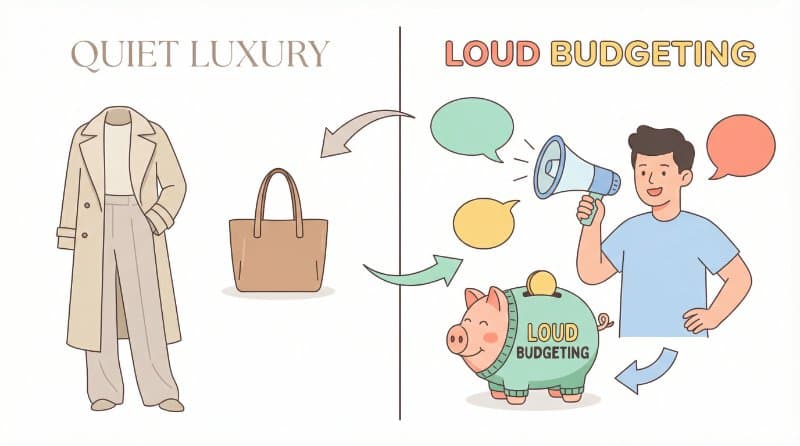
Takeaway 1: From "Inconspicuous Consumption" to Vocal Transparency
The cultural landscape of 2026 has officially moved past the "Quiet Luxury" of 2023—a trend defined by the beige aesthetics of inconspicuous consumption. We have traded the exhausting effort of looking effortlessly rich for the authenticity of being financially secure. This shift is a direct response to the "economic adversity" cited by Dr. David Spohn, including persistent inflation and housing costs that have forced a generational reevaluation of value.
"Loud budgeting is a way to take back one’s power around financial values and goals."
By vocalizing constraints, Gen Z is disrupting the pressure of bottomless spending. This movement democratizes money talk, turning what was once a private struggle into a collective stance of empowerment. It’s no longer about what you own, but how clearly you navigate a volatile economy.
Takeaway 2: The Power of the "Purposeful No"
Vocalizing a "no" creates immediate social accountability. While the "Old Way" relied on vague excuses like "I have a headache," the Loud Budgeting way involves stating a specific objective, such as an emergency fund or a house deposit. This strategy leverages behavioral economics to combat "present bias," reminding you—and your circle—why short-term sacrifices are necessary for future freedom.
To curb the "siren call" of impulse buys, practitioners are adopting the 24-hour rule (or the more rigorous 48-hour rule) to create a temporal buffer before spending. When you do need to set boundaries with others, use these four foolproof phrases:
- "No, I’m trying to save for…" Articulate a major life goal, like a house deposit, to turn loved ones into accountability partners.
- "No, how about instead…" Offer a fail-safe, low-cost alternative like a potluck or a walk in the park to show you value the relationship, not the bill.
- "No, I already have…" Acknowledging you have similar items at home or a filled fridge helps you talk yourself out of redundant purchases.
- "No, I promised myself no more…" Frame your decision as a smart, universal rule you've set for yourself, maintaining your sense of agency.
Takeaway 3: Digital Resilience and the "Finfluencer" Classroom
Generation Z is transforming social media into a decentralized financial academy. Currently, 65% of this cohort relies on "finfluencers" for investment decisions, ranging from the FIRE (Financial Independence, Retire Early) movement to cryptocurrency. To combat income instability, 46% of Gen Z have diversified their income through side hustles or freelance work, often funneling these gains into ESG (Environmental, Social, and Governance) investments.
While these platforms democratize knowledge, the "classroom" requires a critical eye. Approximately 40% of people worry about the credibility of influencer advice. Distinguishing quality education from commercial interest is now a core tenet of digital financial literacy.
Takeaway 4: Peer Accountability Over Peer Pressure
Loud Budgeting reveals a hidden truth: most of your friends are also feeling the cost-of-living squeeze. By being the first to speak up, you kill the FOMO (Fear of Missing Out) for the entire group. This honesty fosters a culture of communal support rather than competitive spending.
Establishing these boundaries allows for a shift toward "budget-friendly lifestyles." Practitioners are finding empowerment in alternatives mentioned by experts and community creators:
- Hosting potlucks and game nights instead of $40-per-plate dinners.
- Getting a library card to eliminate book-buying costs.
- Switching to refillable household and beauty products .
- Opting for "dupes" of luxury fragrances (such as Zara scents) that offer high-end appeal without the triple-digit price tag .
"It's about time there's disruption... where millennials and Gen Z folks are taking control of their personal finances and saying no to the pressures of bottomless spending."
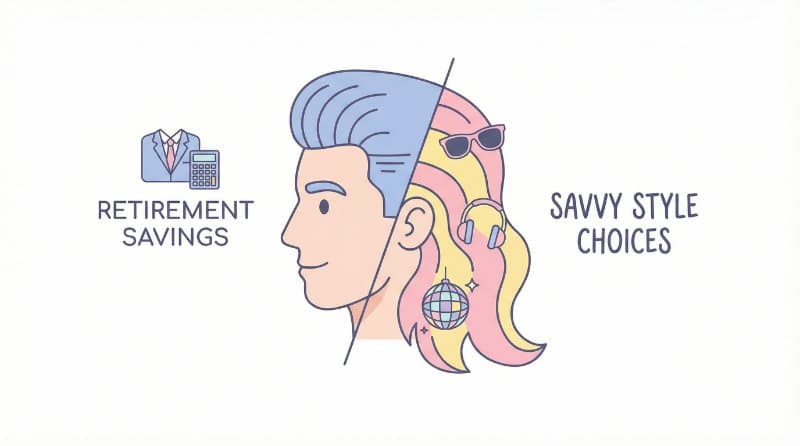
Takeaway 5: The "401(k) Mullet"—Prudent Tools for Modern Living
Gen Z is defining financial responsibility through what cultural analysts call the "401(k) Mullet." It’s business in the front (diligent retirement saving and 401(k) contributions) and a party in the back (making intentional, savvy style choices). While 46% of Gen Z still rely on parents for assistance with housing or bills, they are showing remarkable "discipline and foresight" by using high-tech tools to manage the income they do earn.
The following apps are highly rated by the community for tracking big-picture financial health :
| App | Primary Pro |
|---|---|
| YNAB | Uses a comprehensive envelope budgeting system. |
| Monarch Money | Integrated big picture view; intuitive for couples. |
| NerdWallet | Free tool for tracking big picture financial health. |
| Quicken Simplifi | Simple dashboard of bills and "what's left" calculations. |
| EveryDollar | Cleaner simplistic app layout that "hurts the brain less." |
Conclusion: A New Definition of Success
The rise of Loud Budgeting signifies that financial health in 2026 is communal, transparent, and ethical. Success is being redefined: it is no longer measured by the "quiet luxury" of material possessions, but by the courage to live within one's means and the pursuit of financial independence.
By turning money boundaries into a point of pride, we are building a more inclusive and resilient economic model. As you navigate your next social invite, consider the power of being vocal about your goals.
Which "Loud Budgeting" phrase will you use the next time someone suggests the "awkward split"?
Common Questions
🤔
Frequently Asked Questions
What is Loud Budgeting?▼
Loud Budgeting is a financial trend popularized by Lukas Battle where individuals openly vocalize their financial constraints and goals to avoid social spending pressure, prioritizing long-term savings over short-term appearances.
How can I avoid splitting the bill evenly at restaurants?▼
Use the 'Loud Budgeting' approach by stating your boundaries early. You can say, 'I'm saving for a specific goal, so I'll just be paying for what I ordered today,' or suggest a lower-cost alternative like a potluck before the plan is made.
What are the best budgeting apps for Gen Z in 2026?▼
Top-rated apps include YNAB for envelope budgeting, Monarch Money for couples and big-picture views, NerdWallet for free tracking, Quicken Simplifi for bill management, and EveryDollar for a simple, user-friendly layout.