
Blog2/17/2026
The Shoebill Stork: Africa’s Terrifying 'Living Dinosaur' That Eats Crocodiles
5 minutes Read
The Briefing
Quick takeaways for the curious
The Shoebill Stork is a prehistoric-looking bird native to East African swamps, standing up to 5 feet tall.
Survival involves 'siblicide,' where the stronger chick kills the weaker sibling to secure resources.
They are apex predators that use a 'collapse' technique to hunt lungfish, snakes, and even baby crocodiles.
To cool down in the heat, they practice urohidrosis (urinating on their legs) and gular fluttering.
Conservation efforts are shifting local perceptions from viewing the bird as a 'bad omen' to a valuable ecotourism asset.
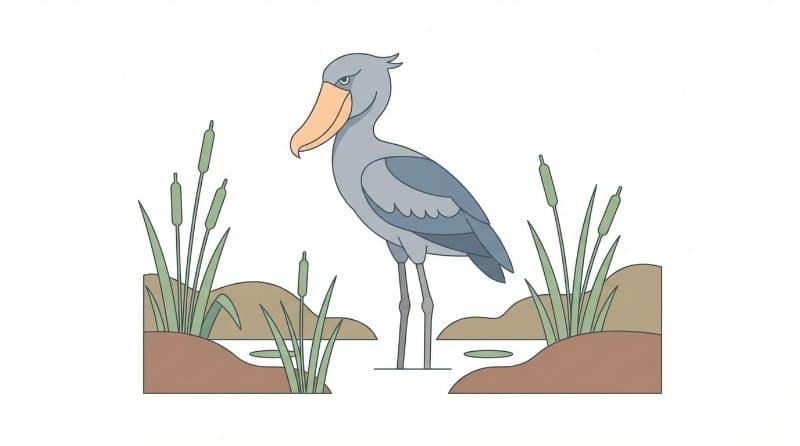
To stand before a Shoebill (Balaeniceps rex) is to step back into the Cretaceous. Standing roughly 140 centimeters tall (nearly five feet), this avian anomaly possesses a visual profile that defies modern classification: it has the spindly, elongated legs of a stork, the massive, bulbous bill of a pelican, and the fierce, predatory head of an eagle. To encounter one in the vast, stagnant freshwater swamps of East Africa is to engage in a silent staring contest you are unlikely to win; the bird is famous for its statuesque stillness, remaining focused for hours on end. To spot these elusive giants in the wild, enthusiasts often rely on high-quality optics to scan the dense papyrus reeds from a distance.
Yet, while its appearance suggests a prehistoric relic that has escaped the march of time, its reality is much more fragile. As the only member of its own family, Balaenicipitidae, the Shoebill is an evolutionary lone wolf whose future currently hangs in a precarious balance.
1. A Ruthless Strategy for Survival (Siblicide)
In the swamp, survival is a zero-sum game that begins in the nest. While a breeding pair typically lays two to three eggs, it is a rare biological "insurance policy" if more than one chick reaches adulthood. This isn't merely a consequence of the harsh environment; it is often a result of deliberate, brutal natural selection among siblings.
The older, stronger chick frequently displays violent aggression toward its smaller siblings—a behavior known as siblicide. This ensures that the intensive resources provided by the parents are not spread thin but are concentrated on the individual with the highest probability of survival. Even after the initial struggle, the mother’s role is one of pragmatism rather than sentiment; she eventually chases the remaining young out of the nest to fend for themselves using the "tricks" they observed during their five-month maturation.
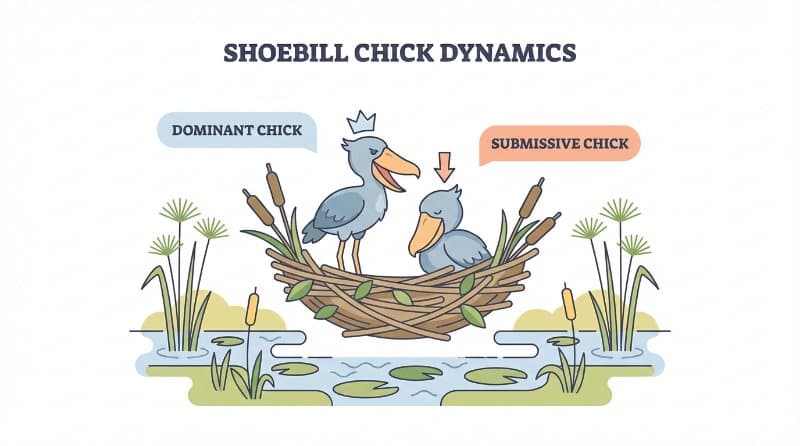
"Recent footage in the Bangweulu Wetlands illustrated well an adult bird ignoring the pleadings of a weaker chick, which was subsequently fatally pecked by the stronger one." — AEWA Report
2. The "Collapsing" Hunter of the Low-Oxygen Wilds
The Shoebill is a specialized apex predator of the marsh, utilizing a "standing and waiting" technique that demands immense patience. Its hunting grounds are strategically chosen: the bird haunts areas of stagnant, low-oxygen water. In these environments, fish like the lungfish and catfish are forced to the surface to gulp air, making them easy targets for the giant lurking above.
The Shoebill’s menu is remarkably diverse, including water snakes, frogs, monitor lizards, young turtles, and even baby crocodiles. The physics of the strike are terrifyingly efficient. To capture its prey, the bird performs a "collapse"—a sudden, high-speed lunge where it falls forward with its wings spread for balance. Its clog-shaped bill, ending in a sharp, lethal hook, acts as a precision tool to scoop up and crush its victim. Because this maneuver is so forceful, the bird must use its massive eight-foot wingspan to regain its footing after the strike. Capturing this split-second action requires a fast shutter speed on a capable camera .
3. Bizarre Cooling Mechanisms (Urohidrosis)
Life in the sweltering East African wetlands requires biological ingenuity. To combat the intense heat, the Shoebill employs a mechanism called urohidrosis. In a process that is highly functional if "un-glamorous," the bird urinating on its own legs. As the liquid evaporates, it provides a vital cooling effect, often leaving the bird's legs with a distinct, chalky appearance from the uric acid.
When the heat becomes truly oppressive, the Shoebill supplements this by "gular fluttering"—rapidly vibrating its throat to release excess body heat. These behaviors underscore a fascinating contrast: the bird possesses an almost royal, statuesque dignity, yet its survival depends on the grittiest of biological adaptations.
4. The High Cost of a "Bad Omen" (Fishermen Conflict)
In several regions, the Shoebill’s greatest threat is a cultural stigma. Among certain fishing communities in Uganda, the bird has long been viewed as a "bad omen." A deep-seated myth suggests that seeing a Shoebill first thing in the morning guarantees a day of empty nets and poor luck.
However, this superstition often masks a more practical conflict. Shoebills are perceived as direct competitors for fish, and their violent "collapse" strikes can scare schools of fish away from human nets. Historically, this led to birds being intentionally killed or driven from their nesting sites. Conservationists are now working to flip this script by demonstrating the bird's ecotourism value. At Mabamba Swamp, former competitors have been trained as site guides, and visitor shades have been constructed to improve the experience for birdwatchers. Travelers visiting these humid swamps often equip themselves with protective gear to stay comfortable while observing these rare birds.

5. A Population on the Edge (The 5,000 – 8,000 Count)
The Shoebill is currently listed as Vulnerable on the IUCN Red List. Based on estimates from researcher Tim Dodman (2002), the global population sits between just 5,000 and 8,000 individuals. Their distribution is "discontinuous" and highly fragmented across inaccessible swamps, making them incredibly difficult to track. Key strongholds include the Sudd in South Sudan, the Malagarasi-Muyovozi in Tanzania, the Kamalondo region of the DR Congo, and the Bangweulu Wetlands in Zambia.
Because these birds are long-lived (up to 35 years) but have extremely low productivity, the loss of even a few individuals is devastating. A primary driver of this loss is fire. In the dry season, when the swamps are most accessible, fires are often set to renew grasslands for cattle or to clear land for agriculture. These fires destroy nests and kill chicks before they can fly. In Zambia’s Bangweulu Wetlands, "Shoebill Guardians" from local communities now patrol the marshes to protect nests from both fire and the illegal live-bird trade, often utilizing durable footwear to navigate the treacherous terrain.
Conclusion: Can We Share the Swamp?
Protecting an "antisocial" and highly specialized species like the Shoebill requires more than simple legal protection; it requires human integration. From the guardians in Zambia to the guides at Mabamba, the most successful conservation models are those that treat the swamp as a shared resource.
The Shoebill plays a vital role in its ecosystem by controlling populations of lungfish and other swamp dwellers, maintaining a delicate ecological balance in the heart of Africa. As we look to the future of these prehistoric giants, we must ask: are we willing to protect a species that refuses to adapt to a human-dominated world, but whose very presence reminds us of the ancient, wild roots of our planet?
Common Questions
🤔
Frequently Asked Questions
Do Shoebill storks actually eat crocodiles?▼
Yes, Shoebill storks are known to eat baby crocodiles. Their massive, sharp-hooked bills allow them to capture and crush small reptiles, including young crocs, monitor lizards, and turtles.
Why do Shoebill storks stand so still?▼
Shoebills utilize a 'stand and wait' hunting strategy. They remain motionless for hours to blend into the swamp environment, waiting for prey like lungfish to surface for air before striking with a sudden collapse.
Are Shoebill storks dangerous to humans?▼
Shoebills are generally not dangerous to humans and are known for being solitary and quiet. However, they are large, powerful wild animals with a formidable bite, so they should be observed from a respectful distance.