
Blog2/19/2026
Rucking vs. Running: Why Elite Soldiers Ditched the Jog for a Backpack
5 minutes Read
The Briefing
Quick takeaways for the curious
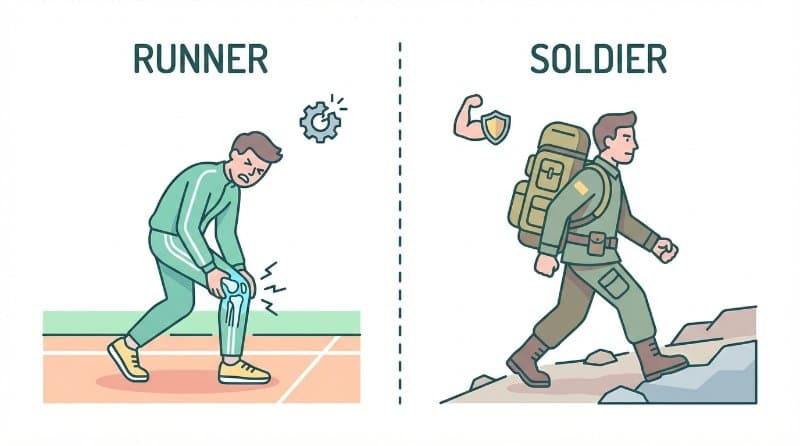
Rucking causes significantly fewer injuries than running (18 vs. 3 in comparative studies) due to the lack of a high-impact 'flight phase'.
It is an ideal Zone 2 training method, keeping heart rates in the fat-burning zone without the recovery tax of jogging.
Loads should generally not exceed 30-33% of body weight to maintain proper posture and prevent cervical spine strain.
Rucking acts as Active Resistance Training (ART), building muscle in the posterior chain and core while burning fat.
Mechanical loading from rucking stimulates osteoblasts, increasing bone density and acting as 'skeletal armor' against aging.
The Injury Gap: Why Elite Units Abandoned the Daily Run
Musculoskeletal injuries cost the Air Force alone over $43.7 million between 2012 and 2014 (Fox et al., 2020). For most athletes, the culprit isn't a lack of effort—it is the repetitive, jarring impact of the daily run. While running is often the default for cardiovascular health, it presents a durability paradox: the activity most used to build fitness is the one most likely to sideline you with "runner’s knee," shin splints, or stress fractures.
Rucking—the military protocol of walking with a weighted pack—is the tactical solution. It offers a sophisticated bridge between strength and endurance, providing the metabolic advantages of a jog with a fraction of the joint stress. By shifting from high-impact "flight phases" to loaded walking, you build a body that is not just fast, but unbreakable.
The Zone 2 Necessity and the 80/20 Rule
To build a legendary aerobic base, you must respect the 80/20 rule: 80% of your training should occur in Zone 2 (60–70% of max heart rate), with only 20% reserved for high-intensity efforts. This is where most runners fail. A standard walk is often too light, lingering in "Zone 1" where heart rates are insufficient to trigger significant aerobic adaptation. Conversely, even a slow jog often spikes the heart rate into Zone 3, leading to systemic burnout rather than base-building.
Rucking provides the precise resistance needed to elevate the heart rate into the fat-burning sweet spot without the recovery tax of running. To monitor this accurately, using a reliable tracker is essential. The gold standard is a conversational pace. If you cannot maintain a steady stream of speech, your intensity has drifted into an anaerobic state, defeating the purpose of the session.
The Biomechanics of the Injury Gap (18 vs. 3)
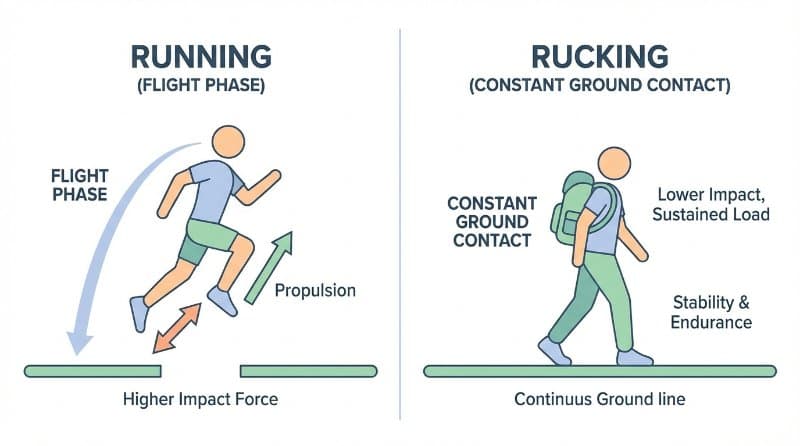
The statistical evidence for rucking over running is undeniable. A University of Pittsburgh study tracking 451 soldiers found that of 28 exercise-related injuries, 18 were caused by running, while only 3 were attributed to rucking.
The disparity is rooted in the "Flight Phase." In running, there is a moment where both feet are off the ground, resulting in massive braking ground reaction forces upon impact. Rucking maintains constant ground contact with at least one foot, facilitating superior force dissipation.
"Research tells us that rucking causes less injuries than running... Our joints and muscles must absorb more impact while running—even at slower paces. It's not called ‘runner's knee’ for nothing." — GORUCK
Active Resistance Training™: Integrated Strength
Rucking is more than "cardio with a backpack"; it is Active Resistance Training™ (ART). It transforms a standard walk into a full-body strength session by engaging a functional integrated system from your shoulders to your feet. To maximize this benefit, utilizing a specialized ensures the weight sits high on the back for optimal stability. Unlike running, which can lead to muscle wasting in the upper body during high-volume blocks, rucking builds muscle while you burn fat.
- Core and Midsection: Rucking creates a powerful isometric training effect on the midsection, specifically strengthening the lower back and improving trunk stability.
- Posterior Chain: The glutes and hamstrings act as the primary drivers, while the upper back and shoulders are recruited to stabilize the load.
- Metabolic Gains: By building and maintaining muscle mass while in an aerobic state, rucking increases your long-term metabolic rate.
Gait Kinematics and the 30% Rule
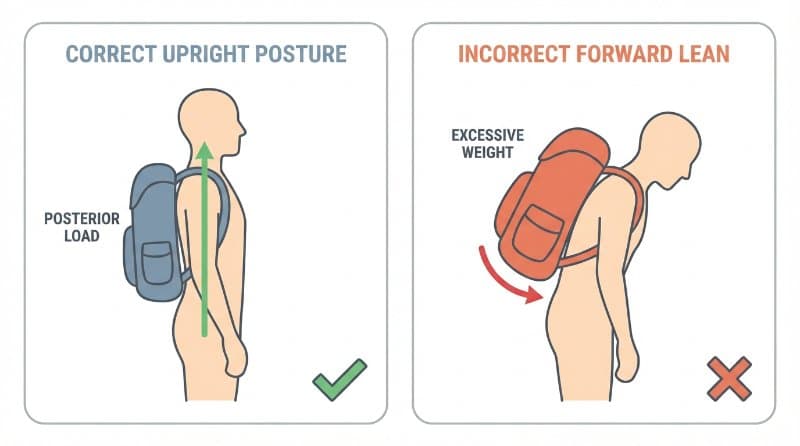
To preserve your biomechanical integrity, you must adhere to the 33% threshold. Researchers suggest that a load should not exceed 30–33% of a bearer’s body weight for non-tactical applications. Once you exceed this, particularly at the 31kg (68.2 lbs) military load mark, gait kinematics shift aggressively. To hit these specific weights accurately, standard weights are preferred over loose items like sandbags or books.
Excessive weight forces a high degree of Trunk Flexion (forward lean) to compensate for a shifting Center of Mass (CoM). This also compromises Craniovertebral angles, leading to a "forward head" posture that strains the cervical spine. Professional rucking-specific packs are superior to a because they provide a posterior load that pulls the shoulders back, reinforcing proper posture rather than forcing the "forward lean" adaptation common in front-heavy vests.
Building "Skeletal Armor" Through Mechanical Loading
For the athlete focused on longevity, rucking acts as a defense against the natural decline of bone density. The sustained Mechanical Loading of a ruck stimulates osteoblasts—the cells responsible for bone formation. To support this load safely, wearing is critical for ankle stability.
This holistic approach to fitness does more than prevent osteoporosis; it enhances balance and coordination, significantly reducing the risk of fractures as you age. By taxing the skeletal system in a controlled, low-impact manner, you are essentially building a suit of armor from the inside out.
Technical Pacing: From Conventional to Special Ops
Mastering the ruck requires understanding the difference between a stroll and a mission-capable pace. For the tactical athlete, the goal is to master the "ruck shuffle"—a method faster than a walk but lower impact than a run.
| Training Category | Recommended Pace | Standard/Load Weight |
|---|---|---|
| Conventional Walk | 14–15 min/mile | Maintenance / 10-20% BW |
| Power Walking | 13–14 min/mile | Sustained Endurance / 50 lbs |
| Ruck Shuffle | 9–10 min/mile | Special Ops Standard / 50 lbs |
| Run Standard (Contrast) | 6 min/mile | Special Ops PFT Standard |
Durable Longevity
Rucking is about "surfing the edges of comfort" to build a body that is functionally integrated and structurally sound. It allows you to compound your strength and cardiovascular gains in a single session while avoiding the orthopedic toll of high-mileage running.
If the world’s most elite soldiers rely on rucking for durability in the face of extreme stress, why are you still pounding the pavement without a pack?
Common Questions
🤔
Frequently Asked Questions
Is rucking better for your knees than running?▼
Yes, generally. Rucking eliminates the 'flight phase' of running, where both feet leave the ground. This significantly reduces the braking ground reaction forces and impact on the knees, making it a safer alternative for cardiovascular fitness.
How much weight should I carry when rucking?▼
For non-tactical applications and injury prevention, researchers suggest a load should not exceed 30–33% of your body weight. Beginners should start with 10-20% of their body weight and gradually increase.
Does rucking build muscle?▼
Yes. Unlike running, which can lead to upper body muscle loss, rucking is a form of Active Resistance Training. It engages the shoulders, core, glutes, and hamstrings, helping to build and maintain muscle mass while improving aerobic capacity.